
Review the key concepts, formulae, and examples before starting your quiz.
🔑Concepts
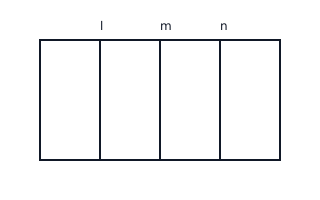
Two lines are said to be parallel if they never meet, no matter how far they are extended. In paper folding, if you fold a paper into a rectangular strip and then unfold it, the vertical creases formed are parallel to each other. The perpendicular distance between these parallel creases remains constant throughout.
Perpendicular lines are formed when two lines intersect at a right angle (). In paper folding, if you have a crease and you fold the paper so that one part of the crease falls exactly on top of the other part, the new crease formed will be perpendicular to .
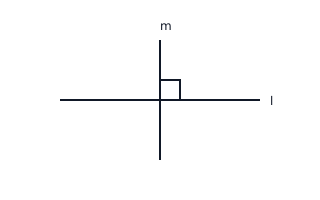
A key property discovered through folding is that if two different creases are both perpendicular to the same third crease, then those two creases must be parallel to each other. Symbolically, if and , then .
Intersecting lines are lines that cross each other at a single point. In paper folding, any two folds that are not parallel and are not on the same line will eventually intersect at a point.
📐Formulae
💡Examples
Problem 1:
A student folds a rectangular sheet of paper twice. The first fold creates crease . The second fold is made by folding the paper such that crease falls exactly on itself, creating crease . What is the angle between crease and crease ?
Solution:
The angle between crease and crease is .
Explanation:
When a line (crease) is folded onto itself, the fold line formed is the perpendicular bisector of the overlapping parts. Therefore, the new crease is perpendicular to the original crease , meaning and the angle is .
Problem 2:
Suppose you have a crease on a paper. You fold the paper to get a crease such that . Then, you fold the paper again to get a crease such that . Describe the relationship between and .
Solution:
Explanation:
According to the properties of lines, if two different lines are perpendicular to the same transversal line, they must be parallel to each other. Here, both and are perpendicular to . Therefore, is parallel to ().
Problem 3:
If the distance between two parallel creases and is at one end of the paper, what will be the distance between them at the other end?
Solution:
Explanation:
By definition, parallel lines () maintain a constant perpendicular distance between them at all points. Therefore, the distance remains .
Problem 4:
Draw a line on a paper. Fold the paper to create a crease that is perpendicular to . Now, create another crease by folding the paper such that is perpendicular to . What is the relationship between line and line ?
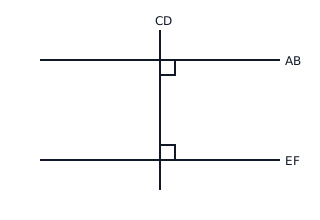
Solution:
- Crease .
- Crease .
- Since both and are perpendicular to the same line , then .
Explanation:
When two lines are perpendicular to the same transversal line, the corresponding angles (which are ) are equal, making the lines parallel.
Problem 5:
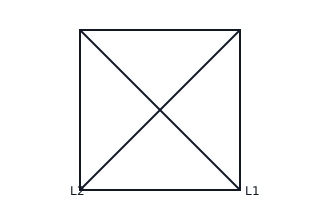
A square sheet of paper is folded exactly in half along its diagonal to create crease . Then it is unfolded and folded in half along the other diagonal to create crease . At what angle do and intersect?
Solution:
In a square, the diagonals bisect each other at right angles. Therefore, the angle of intersection between and is .
Explanation:
Creases and are the diagonals of the square. By geometric property, the diagonals of a square are perpendicular to each other ().