
Review the key concepts, formulae, and examples before starting your quiz.
🔑Concepts
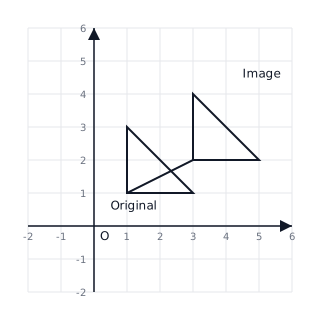
Translation involves sliding a shape to a new position without rotating it or changing its size. Every point moves the same distance in the same direction, defined by a vector , where is the horizontal shift and is the vertical shift.
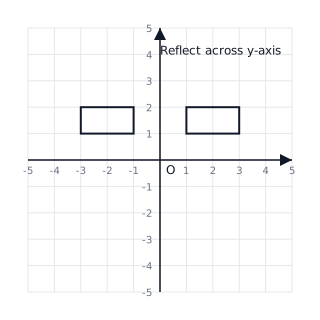
Reflection creates a mirror image of a shape across a 'line of reflection'. For Grade 6, we focus on reflections across the -axis and -axis. Every point and its image are equidistant from this line.
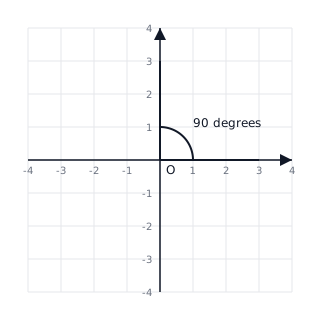
Rotation turns a figure about a fixed point called the center of rotation. We describe the turn using an angle (e.g., or ) and a direction (Clockwise or Counter-clockwise).
Invariant properties: In translation, reflection, and rotation, the size and shape of the object remain the same; these are called 'isometries'. Only the position or orientation changes.
📐Formulae
Translation by vector
Reflection across the -axis:
Reflection across the -axis:
Rotation of about the origin:
Rotation of Clockwise about the origin:
Rotation of Counter-clockwise about the origin:
💡Examples
Problem 1:
A triangle has vertices at , , and . Translate the triangle using the vector and state the new coordinates of vertex .
Solution:
- Identify the translation values: (move 3 units left) and (move 2 units up).
- Apply the formula to the original coordinates of .
- Calculate the new x-coordinate: .
- Calculate the new y-coordinate: .
- The new coordinates for vertex are .
Explanation:
To translate a point, we add the horizontal component of the vector to the coordinate and the vertical component to the coordinate.
Problem 2:
Point is located at . Reflect point across the -axis and then describe the position of the resulting image .
Solution:
- Identify the reflection rule for the -axis: .
- The original coordinate is , so the new coordinate is .
- The coordinate remains unchanged: .
- The image is located at .
Explanation:
When reflecting across the -axis, the point moves horizontally to the opposite side of the vertical axis, so only the sign of the -coordinate changes.
Problem 3:
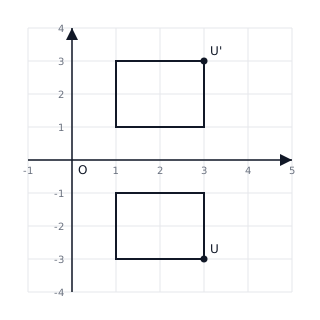
A square has vertices at , , , and . Reflect the square across the -axis and state the new coordinates of vertex .
Solution:
- Identify the rule for reflection across the -axis: .
- Apply the rule to point .
- New -coordinate remains .
- New -coordinate becomes .
- Therefore, is at .
Explanation:
Reflecting across the -axis flips the shape vertically. The horizontal distance from the -axis stays the same, but the sign of the -coordinate is inverted.
Problem 4:
Triangle has vertices , , and . Rotate the triangle Clockwise about the origin and find the new coordinates of .
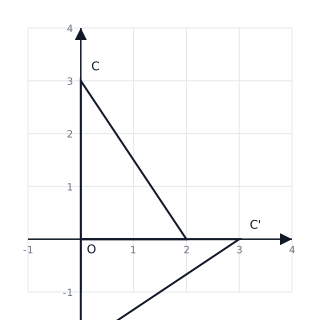
Solution:
- Identify the rule for Clockwise rotation: .
- Apply the rule to vertex .
- The new -coordinate is the old -coordinate: .
- The new -coordinate is the negative of the old -coordinate: .
- Thus, is .
Explanation:
In a clockwise rotation, the vertical component of the original point becomes the horizontal component of the new point, and the horizontal component is flipped to the negative -direction.