
Review the key concepts, formulae, and examples before starting your quiz.
🔑Concepts
A combined transformation is a sequence of two or more transformations applied one after the other. The image produced by the first transformation becomes the object for the second transformation.
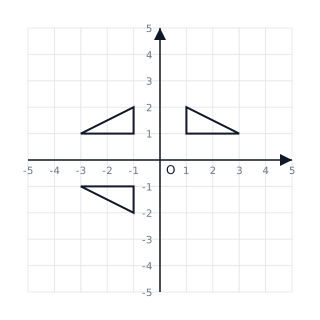
The order of transformations matters. Applying a translation then a reflection may result in a different final position than applying the reflection then the translation.
Multiple translations can be combined by adding their vectors. For example, a translation by followed by is equivalent to a single translation of .
When reflecting an object twice across two parallel lines, the result is equivalent to a single translation. When reflecting across two intersecting lines, the result is a rotation.
📐Formulae
\begin{pmatrix} a \ b \end{pmatrix} roller
💡Examples
Problem 1:
A triangle has a vertex at . It is first translated by the vector and then reflected across the -axis. Find the final coordinates of point .
Solution:
Step 1 (Translation): Add the vector components to the coordinates: Step 2 (Reflection): Reflect across the -axis by changing the sign of the -coordinate: The final coordinates are .
Explanation:
We first apply the translation to the original point to get an intermediate point . We then apply the reflection rule for the -axis, which is , to to find the final position.
Problem 2:
Point is at . It is reflected across the -axis and then rotated about the origin. Determine the final position of .
Solution:
Step 1 (Reflection in -axis): Step 2 (Rotation ): The final coordinates are .
Explanation:
Reflecting across the -axis negates the -value. Rotating negates both the and values of the intermediate point.
Problem 3:
Calculate the total vertical shift if a shape is translated by and then by .
Solution:
The final vertical translation is units up.
Explanation:
When combining translations, we can simply add the corresponding components of the vectors. .
Problem 4:
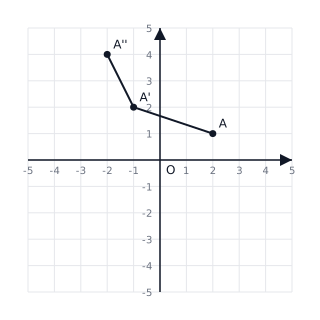
A square has a vertex at . It is rotated counter-clockwise about the origin and then translated by the vector . Determine the final coordinates of vertex .
Solution:
- Rotation: The rule for counter-clockwise rotation about is . Applying this to gives .
- Translation: Apply the vector to . . The final coordinates are .
Explanation:
First, we apply the rotation rule to find the intermediate position. Then, we add the translation components to the intermediate and values to find the final position.
Problem 5:
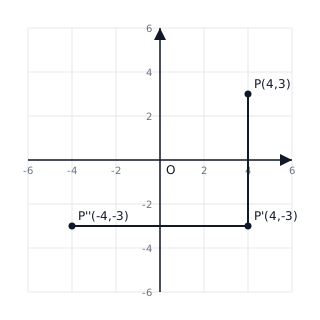
A shape is reflected in the line (-axis) and then reflected again in the line (-axis). If a point on the shape was at , where is it now?
Solution:
- Reflection in -axis: The rule is . Point becomes .
- Reflection in -axis: The rule is . Point becomes . Final position: .
Explanation:
Reflecting across the x-axis flips the sign of the y-coordinate. Reflecting that result across the y-axis flips the sign of the x-coordinate. This combined transformation is equivalent to a rotation about the origin.