
Review the key concepts, formulae, and examples before starting your quiz.
🔑Concepts
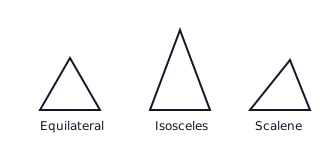
Classification by Sides: Triangles can be categorized based on the lengths of their sides. An equilateral triangle has three equal sides (). An isosceles triangle has at least two equal sides. A scalene triangle has no equal sides.
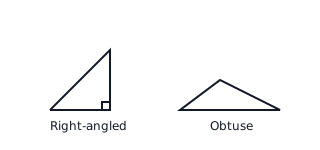
Classification by Angles: Triangles are also classified by their interior angles. An acute triangle has all angles less than . A right-angled triangle has one angle exactly . An obtuse triangle has one angle greater than .
The Angle Sum Property: The sum of the interior angles of any triangle is always . This property allows us to find a missing angle if two are known using the formula .
The Triangle Inequality Theorem: For any triangle, the sum of the lengths of any two sides must be strictly greater than the length of the third side (). If this condition is not met, the three segments cannot form a closed triangle.
📐Formulae
Sum of interior angles:
Area of a triangle:
Perimeter of a triangle:
Triangle Inequality: , , and
💡Examples
Problem 1:
In an isosceles triangle, the vertex angle (the angle between the two equal sides) measures . Calculate the size of the two remaining base angles.
Solution:
Step 1: Let the two equal base angles be represented by . Step 2: Since the sum of angles is , the equation is . Step 3: Simplify to . Step 4: Subtract from both sides: . Step 5: Divide by : .
Explanation:
This solution uses the property that an isosceles triangle has two equal angles and the fact that the total interior sum must be .
Problem 2:
Find the area of a triangle where the base is and the perpendicular height is .
Solution:
Step 1: Identify the values: and . Step 2: Use the area formula . Step 3: Substitute the values: . Step 4: Calculate . Final Answer: .
Explanation:
The area is calculated by taking half of the product of the base and the vertical height that is perpendicular to that base.
Problem 3:
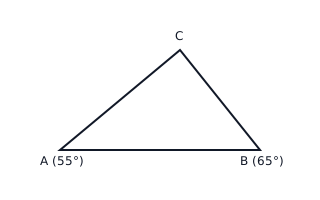
In the triangle shown, angle and angle . Calculate the size of angle .
Solution:
Explanation:
Since the sum of interior angles in a triangle is always , we add the two known angles and subtract the result from to find the third angle.
Problem 4:
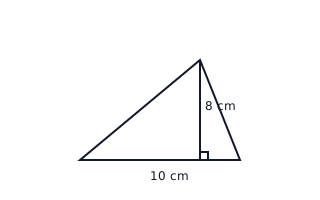
A triangle has a base of and a height of . A second triangle is identical in shape but its base is . Find the area of the first triangle.
Solution:
Explanation:
To find the area, we identify the base () and the perpendicular height () and apply the area formula for triangles.