
Review the key concepts, formulae, and examples before starting your quiz.
🔑Concepts
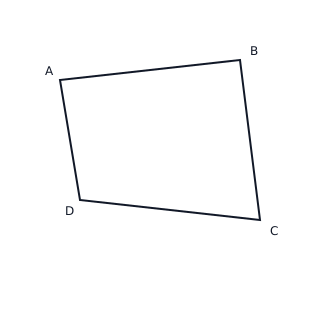
A quadrilateral is a polygon with four sides, four vertices, and four interior angles. The sum of the interior angles of any quadrilateral is always .
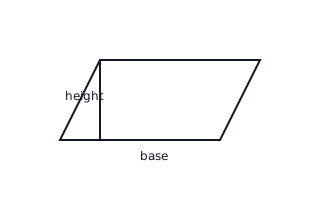
A Parallelogram is a quadrilateral where opposite sides are parallel and equal in length. Opposite angles are also equal.
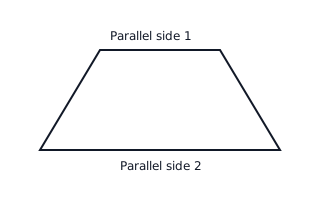
A Trapezium (or Trapezoid) is a quadrilateral with at least one pair of parallel sides. If the non-parallel sides are equal, it is called an isosceles trapezium.
A Kite is a quadrilateral with two pairs of adjacent sides that are equal in length. Its diagonals intersect at right angles ().

📐Formulae
Sum of interior angles:
Perimeter of any quadrilateral:
Area of a Rectangle:
Area of a Square:
Area of a Parallelogram:
Perimeter of a Rhombus or Square:
💡Examples
Problem 1:
In a quadrilateral , three of the interior angles are , , and . Find the measure of the fourth angle, .
Solution:
- Recall the Angle Sum Property: The sum of all angles in a quadrilateral is .
- Set up the equation: .
- Add the known angles: .
- Subtract the sum from : .
- Result: .
Explanation:
Since any quadrilateral can be split into two triangles, its total internal degrees must equal . We subtract the sum of the known angles from this total to find the missing value.
Problem 2:
Calculate the perimeter of a rhombus where one side measures cm.
Solution:
- Identify the property: In a rhombus, all four sides are equal in length.
- Use the formula: .
- Substitute the value: .
- Calculate: .
Explanation:
Because a rhombus is equilateral (all sides equal), you simply multiply the length of one side by four to find the total distance around the shape.
Problem 3:
Given a rectangle with a length of cm and a diagonal of cm, find the width of the rectangle.
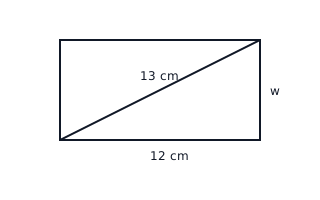
Solution:
- Let the width be . In a rectangle, the diagonal forms a right-angled triangle with the length and width.
- Using the Pythagorean theorem:
- cm.
Explanation:
Because a rectangle has four right angles, we can use the Pythagorean theorem on the triangle formed by two sides and the diagonal.
Problem 4:
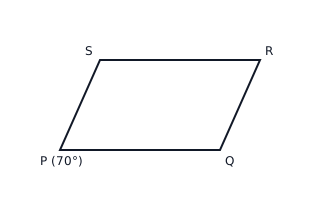
In the parallelogram , . Find the measures of the remaining three angles.
Solution:
- In a parallelogram, opposite angles are equal: .
- Adjacent angles are supplementary (sum to ): .
- Since is opposite to , .
- The angles are , , , and .
Explanation:
Properties of parallelograms state that opposite angles are equal and consecutive (adjacent) angles add up to 180 degrees.