krit.club logo

Shape and Space - Lines and Angles (Acute, Obtuse, Right, Straight, Reflex)

Grade 6IB

Review the key concepts, formulae, and examples before starting your quiz.

🔑Concepts

•

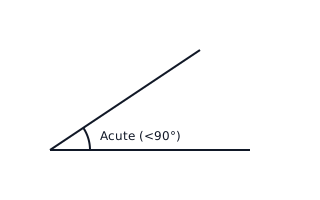
An acute angle is a small angle that measures more than 0∘0^{\circ} but less than 90∘90^{\circ}.

Diagram showing an acute angle less than 90 degrees.
•

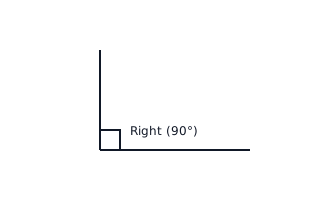
A right angle measures exactly 90∘90^{\circ} and forms a perfect 'L' shape.

Diagram showing a right angle of 90 degrees.
•

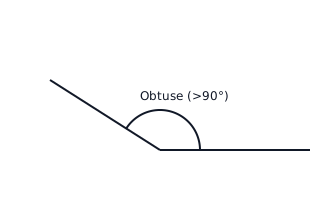
An obtuse angle is wider than a right angle, measuring more than 90∘90^{\circ} but less than 180∘180^{\circ}.

Diagram showing an obtuse angle between 90 and 180 degrees.
•

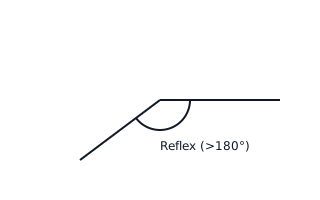
A reflex angle is an angle that measures more than 180∘180^{\circ} but less than 360∘360^{\circ}.

Diagram showing a reflex angle greater than 180 degrees.

📐Formulae

Acute Angle: 0∘<θ<90∘\text{Acute Angle: } 0^{\circ} < \theta < 90^{\circ}

Right Angle: θ=90∘\text{Right Angle: } \theta = 90^{\circ}

Obtuse Angle: 90∘<θ<180∘\text{Obtuse Angle: } 90^{\circ} < \theta < 180^{\circ}

Straight Angle: θ=180∘\text{Straight Angle: } \theta = 180^{\circ}

Reflex Angle: 180∘<θ<360∘\text{Reflex Angle: } 180^{\circ} < \theta < 360^{\circ}

Angles on a Straight Line: a+b=180∘\text{Angles on a Straight Line: } a + b = 180^{\circ}

Angles around a Point: a+b+c+...=360∘\text{Angles around a Point: } a + b + c + ... = 360^{\circ}

Complementary Angles: a+b=90∘\text{Complementary Angles: } a + b = 90^{\circ}

💡Examples

Problem 1:

Two angles lie on a straight line. If one angle measures 65∘65^{\circ}, calculate the value of the missing angle xx.

Solution:

  1. Identify the relationship: Angles on a straight line sum to 180∘180^{\circ}.
  2. Set up the equation: x+65∘=180∘x + 65^{\circ} = 180^{\circ}.
  3. Subtract 65∘65^{\circ} from both sides: x=180∘−65∘x = 180^{\circ} - 65^{\circ}.
  4. Calculate the result: x=115∘x = 115^{\circ}.

Explanation:

Since the angles are supplementary (forming a straight line), we subtract the known angle from 180∘180^{\circ} to find the unknown. The resulting angle is obtuse.

Problem 2:

An interior angle of a triangle is measured as 110∘110^{\circ}. Calculate the reflex angle yy that exists on the outside of this vertex.

Solution:

  1. Identify the relationship: A full rotation around a point is 360∘360^{\circ}.
  2. Set up the equation: y+110∘=360∘y + 110^{\circ} = 360^{\circ}.
  3. Subtract 110∘110^{\circ} from both sides: y=360∘−110∘y = 360^{\circ} - 110^{\circ}.
  4. Calculate the result: y=250∘y = 250^{\circ}.

Explanation:

To find a reflex angle when the interior angle is known, subtract the interior angle from a full circle (360∘360^{\circ}). The result 250∘250^{\circ} is a reflex angle because it is between 180∘180^{\circ} and 360∘360^{\circ}.

Problem 3:

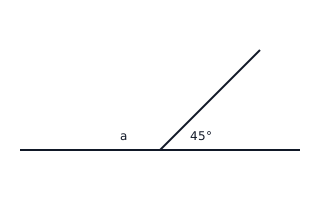
Find the value of the missing angle aa in the diagram, where the two angles meet at a point on a straight line and the known angle is 45∘45^{\circ}.

A straight line split by another line into an angle of 45 degrees and an unknown angle a.

Solution:

a=180∘−45∘a = 180^{\circ} - 45^{\circ} a=135∘a = 135^{\circ}

Explanation:

Angles on a straight line always sum to 180∘180^{\circ}. To find the unknown angle, we subtract the given angle from 180∘180^{\circ}.

Problem 4:

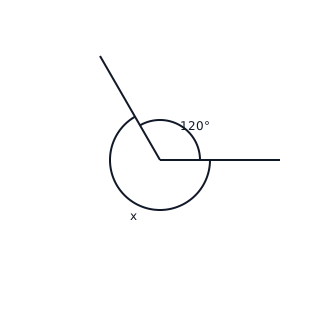
Calculate the value of the reflex angle xx if the interior angle is 120∘120^{\circ}.

Two lines meeting at a point showing an interior angle of 120 degrees and an exterior reflex angle x.

Solution:

x=360∘−120∘x = 360^{\circ} - 120^{\circ} x=240∘x = 240^{\circ}

Explanation:

Angles around a point sum to 360∘360^{\circ}. The reflex angle and the interior angle together form a full circle (360∘360^{\circ}), so we subtract 120∘120^{\circ} from 360∘360^{\circ} to find xx.