
Review the key concepts, formulae, and examples before starting your quiz.
🔑Concepts
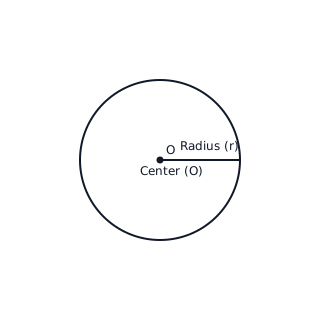
The center is the fixed point in the middle of the circle, and every point on the boundary is at an equal distance from this center. The radius is the line segment connecting the center to any point on the boundary.
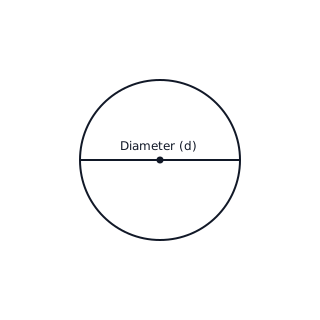
The diameter is a line segment passing through the center with both endpoints on the circle's boundary. It is the longest chord and its length is exactly twice the radius ().
The circumference is the total distance around the edge of the circle (the perimeter). The ratio of the circumference to the diameter is always a constant called (approximately or ).
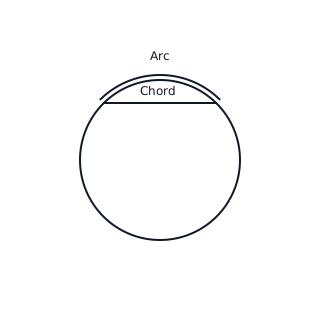
A chord is any line segment joining two points on a circle. A chord that passes through the center is a diameter. An arc is any part of the circumference.
📐Formulae
💡Examples
Problem 1:
If a circle has a radius of , what is its diameter?
Solution:
Explanation:
Since the diameter is twice the length of the radius, we multiply the given radius () by .
Problem 2:
Calculate the circumference of a circle with a diameter of using .
Solution:
Explanation:
Using the formula , we substitute for and for to get the perimeter of the circle.
Problem 3:
A circular garden has a diameter of . Find its radius and the distance around the garden (circumference) using .
Solution:
Explanation:
First, we find the radius by dividing the diameter by . Then, we calculate the circumference using the fractional value of to simplify the multiplication with the diameter.
Problem 4:
Find the area of a circle with a radius of (Take ).
Solution:
Explanation:
The area is calculated by squaring the radius () and then multiplying the result by ().
Problem 5:
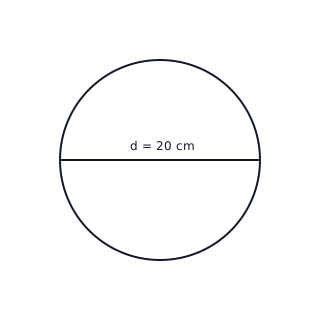
Calculate the area of a circular tabletop that has a diameter of . Use .
Solution:
- Find the radius: .
- Use the area formula: .
- Substitute the values: .
- .
Explanation:
To find the area, we must first convert the diameter into a radius. Since the radius is half the diameter, we use in the area formula.
Problem 6:
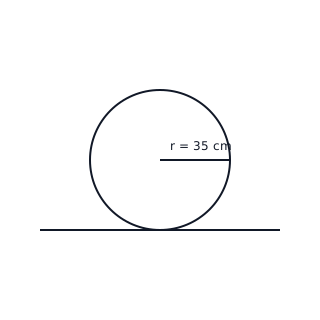
A bicycle wheel has a radius of . How far does the wheel travel in one full rotation? (Use )
Solution:
- The distance traveled in one rotation is equal to the circumference ().
- Use the formula: .
- Substitute the values: .
- Simplify: .
- .
Explanation:
One full rotation of a wheel is equivalent to its circumference. We use the radius provided and the fraction value of to simplify the calculation.