
Review the key concepts, formulae, and examples before starting your quiz.
🔑Concepts
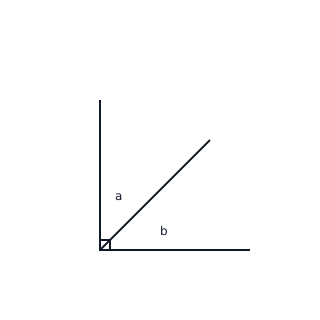
Complementary angles are two angles whose measures add up to , forming a right angle.
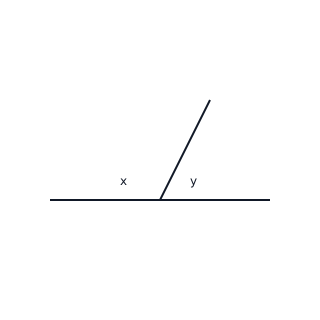
Supplementary angles are two angles whose measures add up to , creating a straight line.
Vertically opposite angles are formed when two lines intersect. They are equal in measure.

Angles around a point always sum to , representing a full rotation.
📐Formulae
(Complementary Angles)
(Supplementary Angles)
(Vertically Opposite)
💡Examples
Problem 1:
Find the value of if and are complementary angles.
Solution:
- Since the angles are complementary, their sum is .
- Write the equation: .
- Subtract from both sides: .
- Calculate: .
Explanation:
We use the property that complementary angles must add up to a right angle ().
Problem 2:
Two lines intersect to form an 'X'. If one angle is , find the measure of its vertically opposite angle and the measure of an adjacent supplementary angle.
Solution:
- Vertically opposite angles are equal, so the opposite angle is .
- Adjacent angles on a straight line are supplementary, so their sum is .
- Let the adjacent angle be : .
- Solve for : .
Explanation:
This problem applies two rules: opposite angles in an intersection are equal, and angles on a straight line total .
Problem 3:
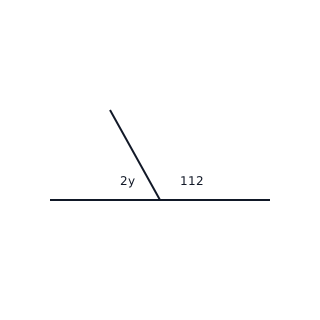
In the following figure, the angles and lie on a straight line. Calculate the value of .
Solution:
- Since the angles are on a straight line, they are supplementary.
- Write the equation: .
- Subtract from both sides: .
- Divide by 2: .
Explanation:
Supplementary angles must sum to . Solving for involves isolating the variable through subtraction and division.
Problem 4:
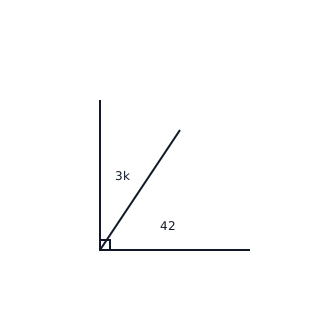
Given that the angles shown are complementary, find the value of if one angle is and the other is .
Solution:
- Complementary angles sum to .
- Write the equation: .
- Subtract from both sides: .
- Divide by 3: .
Explanation:
Because the outer rays form a right angle (), the sum of the inner angles equals .