
Review the key concepts, formulae, and examples before starting your quiz.
🔑Concepts
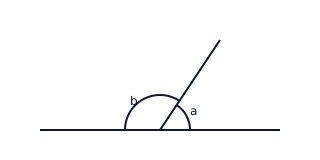
Angles on a straight line always sum to . These are also known as supplementary angles when two angles add up to this total.
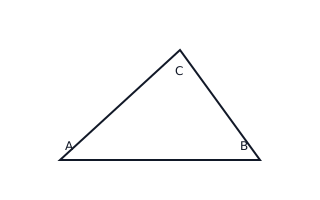
The sum of interior angles in any triangle is exactly . This property allows us to find a missing angle if two are known.
Angles around a point sum to , forming a full rotation.
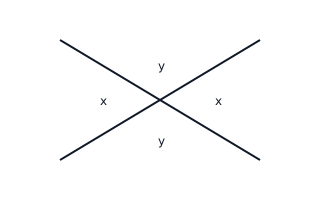
Vertically opposite angles are formed when two straight lines intersect. These angles are always equal to each other.
📐Formulae
💡Examples
Problem 1:
Two angles lie on a straight line. One angle is . Find the value of the missing angle .
Solution:
Explanation:
Since angles on a straight line must sum to , we subtract the known angle from using vertical subtraction:
Problem 2:
In a triangle, two angles are and . Calculate the third angle .
Solution:
Explanation:
The sum of interior angles in a triangle is . First, find the sum of the known angles (), then subtract from .
Problem 3:
Four angles meet at a point. Three of the angles are , , and . Find the fourth angle .
Solution:
Explanation:
Angles around a point sum to . We add the known angles together to get and subtract this from .
Problem 4:
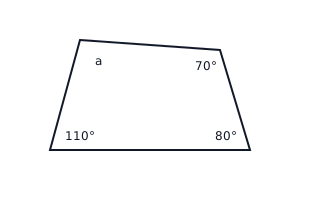
Calculate the value of the missing angle in the given quadrilateral where three angles are , , and .
Solution:
- Recall that the sum of angles in a quadrilateral is .
- Add the known angles: .
- Subtract the sum from :
Explanation:
Since any quadrilateral can be split into two triangles, its total internal angle sum is always . By subtracting the known values from , we find the remaining angle.
Problem 5:
Find the value of angle which is complementary to an angle of .
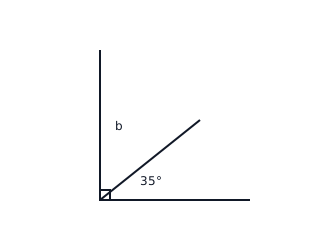
Solution:
- Complementary angles sum to .
- Set up the equation:
- Subtract from both sides:
Explanation:
Complementary angles form a right angle (). If one part is known, the other is the difference between and the known angle.