
Review the key concepts, formulae, and examples before starting your quiz.
🔑Concepts
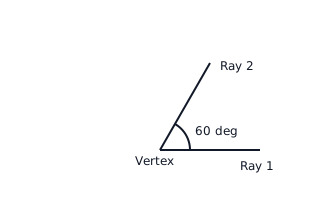
An angle is formed by two rays originating from a common endpoint called the vertex. We measure the rotation between these rays in degrees, where a full revolution is . Angles are classified into several types based on their measure: Acute (), Right (), Obtuse ( and ), Straight (), Reflex ( and ), and Complete ().
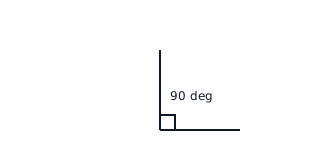
A right angle is exactly and represents one-fourth of a full revolution. It is often represented by a small square symbol at the vertex.
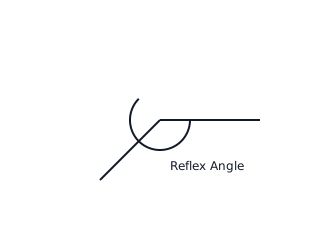
A reflex angle is an angle that is greater than but less than . It represents more than a semi-circle of rotation.
A straight angle is exactly and forms a straight line. It is equivalent to half a revolution.
📐Formulae
💡Examples
Problem 1:
Classify the following angles based on their measures: , , , , and .
Solution:
: Acute Angle, : Obtuse Angle, : Right Angle, : Straight Angle, : Reflex Angle.
Explanation:
We compare each value against the standard definitions: angles are acute, is right, is obtuse, is straight, and is reflex.
Problem 2:
What fraction of a revolution does the hour hand of a clock turn through when it goes from to ?
Solution:
Explanation:
A full clock face represents hours and . Moving from to covers hours. The fraction is , which simplifies to . In degrees, this is (a right angle).
Problem 3:
If an interior angle of a shape is , what is the measure of the corresponding reflex angle at that vertex?
Solution:
Explanation:
The sum of an angle and its reflex angle at a point is . Therefore, to find the reflex angle, subtract the given angle from .
Problem 4:
Find the sum of a right angle and a straight angle.
Solution:
Explanation:
A right angle is and a straight angle is . Adding them gives , which is a reflex angle.
Problem 5:
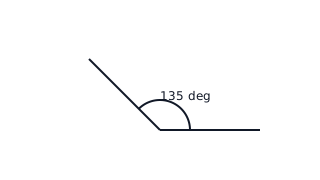
Identify the type of angle shown in the figure which measures . If this angle is subtracted from a complete angle, what is the measure of the remaining angle?
Solution:
is an Obtuse angle. Remaining angle = .
Explanation:
Since , it is classified as an obtuse angle. A complete angle is . Subtracting the given angle from gives , which is a reflex angle.
Problem 6:
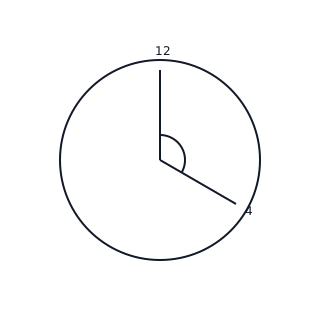
Calculate the measure of the angle formed between the hands of a clock at 4 o'clock. What fraction of a complete revolution is this?
Solution:
Angle at 4 o'clock = Fraction of revolution =
Explanation:
A clock is divided into 12 equal segments. Each segment between two numbers represents . At 4 o'clock, the minute hand is at 12 and the hour hand is at 4, spanning 4 segments. The angle is . This is of a full revolution.