
Review the key concepts, formulae, and examples before starting your quiz.
🔑Concepts
A point is a position in space represented by a fine dot. It has no length, breadth, or thickness. Points are usually denoted by capital letters like , , or .

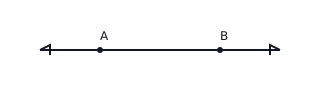
A line is a collection of points that extends infinitely in both directions. It has no endpoints and no definite length. It is denoted as or by a small letter like .
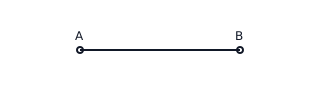
A line segment is a part of a line with two fixed endpoints. It has a definite length that can be measured. It is denoted as .
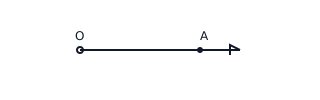
A ray is a part of a line that starts at one point (the initial point) and goes infinitely in one direction. It is denoted as .
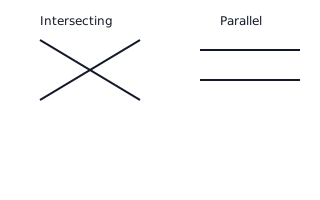
Intersecting lines are two lines that meet at exactly one point. This point is called the point of intersection. Parallel lines are lines in the same plane that never meet, no matter how far they are extended.
📐Formulae
💡Examples
Problem 1:
How many lines can pass through (i) one given point , and (ii) two given points and ?
Solution:
(i) An infinite number of lines can pass through a single point . (ii) Exactly one unique line can pass through two distinct points and .
Explanation:
From a single point, we can draw lines in every possible direction. However, to fix a specific straight path, we need at least two distinct points.
Problem 2:
Name the line segments shown in a triangle with vertices , , and .
Solution:
The line segments are , , and .
Explanation:
A triangle is formed by three line segments joining three non-collinear points. Each side is a line segment with two endpoints.
Problem 3:
If the length of segment and segment , and lies between and on a straight line, find the length of .
Solution:
Length of Length of .
Explanation:
Since the points are collinear and is between and , the total length of the segment is the sum of the individual parts.
Problem 4:
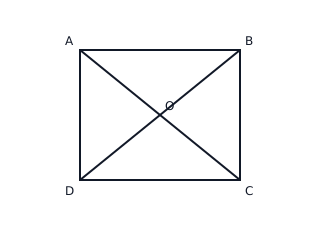
Identify and name all the pairs of intersecting lines shown in the quadrilateral with diagonals and intersecting at .
Solution:
The pairs of intersecting lines (or line segments) are:
- and at point .
- and at point .
- and at point .
- and at point .
- and at point .
Explanation:
Any two lines that cross each other at a single point are called intersecting lines. In a quadrilateral with diagonals, the sides meet at vertices and the diagonals meet each other inside the figure.
Problem 5:
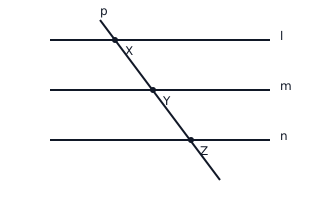
In the given figure, three lines , , and are parallel. If a transversal line intersects them, name the points of intersection.
Solution:
The points of intersection of line with lines , , and are points , , and respectively.
Explanation:
A line that intersects two or more lines at distinct points is called a transversal. Here, is the transversal intersecting the three parallel lines.