
Review the key concepts, formulae, and examples before starting your quiz.
🔑Concepts
Comparing angles by inspection: Sometimes we can tell which angle is larger just by looking at them. An angle with a wider opening between its two rays is the larger angle.
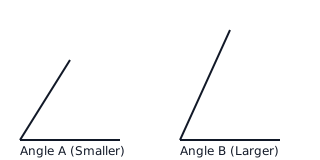
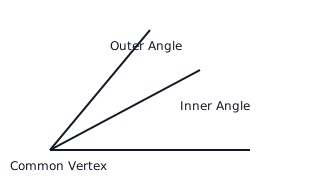
Comparison by superposition: To compare two angles exactly without a protractor, we can trace one angle on a piece of paper and place it over the other angle. If the rays of the traced angle fall inside the other, the traced angle is smaller.
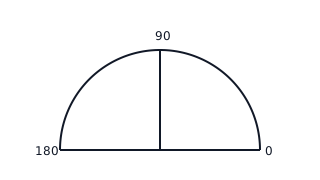
Measuring with a Protractor: The most accurate way to compare angles is to measure their magnitude in degrees. A right angle is exactly . If and , then .
Clock Hands as an Angle Comparator: The angle between the hands of a clock changes as time progresses. At 3 o'clock, the angle is (Right Angle), while at 2 o'clock, the angle is smaller (, Acute Angle).
📐Formulae
💡Examples
Problem 1:
Compare and if and . Which one is larger?
Solution:
Explanation:
By comparing the numerical values of the measures, we see that . Therefore, has a greater opening than .
Problem 2:
Identify which angle is larger: a right angle or an acute angle.
Solution:
Explanation:
A right angle is exactly , whereas an acute angle is always less than . Thus, the right angle is always larger than any acute angle.
Problem 3:
Two angles are given. is part of a square's corner, and is . Which is smaller?
Solution:
Explanation:
A corner of a square is a right angle, which measures . Since , is the smaller angle.
Problem 4:
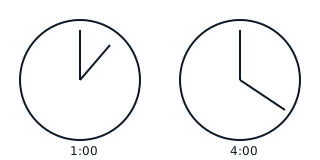
Compare the angles formed by the hands of a clock at 1:00 and 4:00. Which time shows a larger angle?
Solution:
Explanation:
On a clock, each hour mark represents an angle of . At 1:00, the hands are 1 hour mark apart (). At 4:00, the hands are 4 hour marks apart (). Therefore, the angle at 4:00 is larger.
Problem 5:
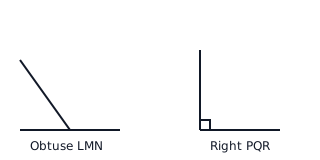
Given and , determine which is larger if is an obtuse angle and is a right angle.
Solution:
Explanation:
By definition, a right angle measures exactly , whereas an obtuse angle is any angle that measures more than but less than . Since any value greater than 90 is larger than 90, the obtuse angle is larger.