
Review the key concepts, formulae, and examples before starting your quiz.
🔑Concepts
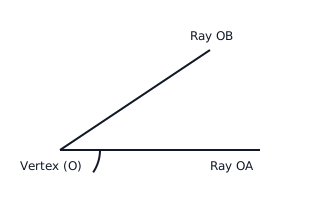
An angle is formed by two rays meeting at a common endpoint called the vertex. The standard unit of measurement is degrees ().
A protractor is used to measure and draw angles. It has two scales: the inner scale (0 to 180 CCW) and the outer scale (0 to 180 CW).
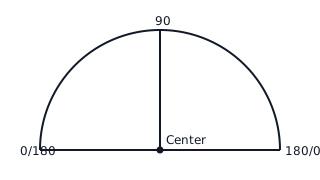
To draw an angle like , align the protractor's baseline with the ray and the center point with the vertex. Mark the point at on the appropriate scale.
Reflex angles (greater than ) can be drawn by subtracting the angle from and drawing the remaining interior angle, then indicating the outer rotation.
📐Formulae
💡Examples
Problem 1:
Draw an angle of and name its type.
Solution:
- Draw a ray . 2. Place the center of the protractor on and the baseline on . 3. Count from on the scale that starts at and mark a point at . 4. Join . .
Explanation:
Since , the angle is an obtuse angle.
Problem 2:
How do you draw a reflex angle of using a standard protractor?
Solution:
1. Draw a ray . 2. At point , draw an angle of in the clockwise direction (below the ray). 3. The exterior/remaining part of the angle at the vertex represents .
Explanation:
To draw a reflex angle, we calculate the difference between and the reflex angle, then draw that remaining angle. The outer part is the required reflex angle.
Problem 3:
Identify the type of angle formed if the measure is .
Solution:
It is an acute angle.
Explanation:
Any angle measuring less than is classified as acute. Since , it fits this definition.
Problem 4:
Draw an obtuse angle using a protractor.
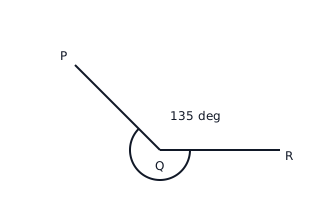
Solution:
- Draw a ray .
- Place the center of the protractor on and align the baseline with .
- Starting from on the side of , find on the scale and mark point .
- Join to form the angle.
Explanation:
Since , this is an obtuse angle.
Problem 5:
Draw a right angle and verify it using a protractor.
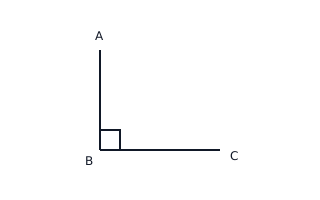
Solution:
- Draw a horizontal ray .
- Use the protractor to mark a point at exactly .
- Connect and . The angle will be .
Explanation:
A right angle is exactly one-quarter of a full turn, represented by a square symbol at the vertex.