
Review the key concepts, formulae, and examples before starting your quiz.
🔑Concepts
The rotating arm concept helps visualize how an angle is formed by the rotation of a ray from its initial position to its terminal position. A full circle rotation is equivalent to one complete revolution or .
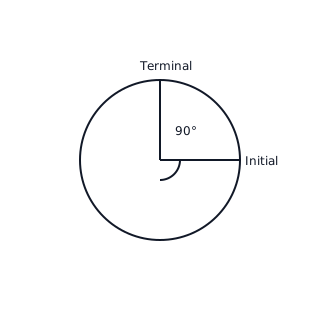
Direction of rotation matters: moving clockwise or anti-clockwise from a reference point like North, South, East, or West creates specific angles. For example, moving from North to South is a half-turn or .
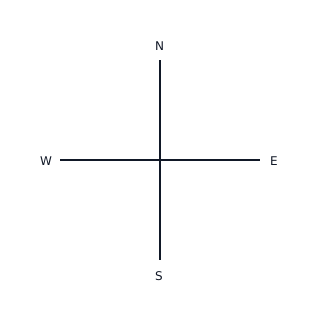
A right angle () represents of a revolution. A straight angle () represents of a revolution. A complete turn () is whole revolution.
Angles between and are acute, between and are obtuse, and angles greater than but less than are reflex angles.
📐Formulae
💡Examples
Problem 1:
If a rotating arm moves from North to East in a clockwise direction, what fraction of a revolution has it completed and what is the angle formed?
Solution:
Fraction = , Angle =
Explanation:
The four main directions (North, East, South, West) divide a circle into four equal parts. Moving from North to East is one part out of four, which is of a revolution. Since a full revolution is , the angle is .
Problem 2:
What is the measure of the angle formed by the hands of a clock when it moves from to ?
Solution:
Explanation:
The movement from to on a clock face represents exactly half of the circular face. This is of a revolution. , which is also known as a straight angle.
Problem 3:
Classify an angle that measures .
Solution:
Reflex Angle
Explanation:
Any angle that is greater than but less than is classified as a reflex angle. Since , it is a reflex angle.
Problem 4:
A rotating arm starts at North and turns clockwise to reach South-West. What is the angle of rotation and what fraction of a revolution has it covered?
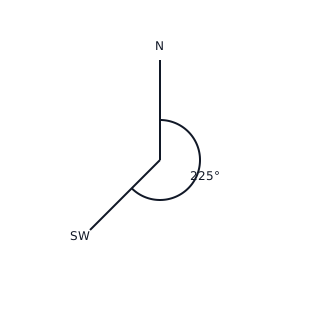
Solution:
- From North to South (clockwise) is ( revolution).
- From South to South-West is half of a right angle, which is ( revolution).
- Total angle = .
- Fraction of revolution = .
Explanation:
Moving from North to South is a straight line (). Adding the movement to the midway point between South and West adds another , totaling .
Problem 5:
Determine the angle and the fraction of the revolution when a clock hand moves from to .
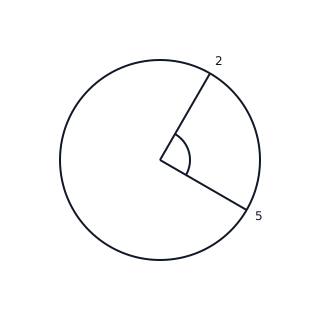
Solution:
- Each hour mark on a clock represents .
- The hand moves from to , which is hour spaces.
- Angle = .
- Fraction = revolution.
Explanation:
Since the clock is divided into 12 equal sectors, moving through 3 sectors constitutes a quarter of the total rotation.