
Review the key concepts, formulae, and examples before starting your quiz.
🔑Concepts
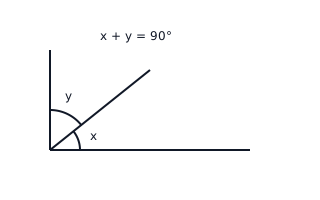
Complementary Angles: Two angles are called complementary if the sum of their measures is . Each angle is called the complement of the other.
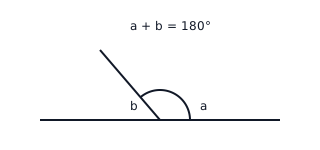
Supplementary Angles: Two angles are called supplementary if the sum of their measures is . Each angle is called the supplement of the other.
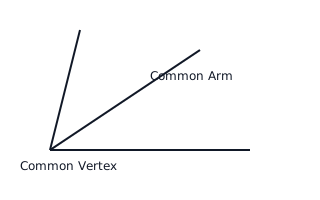
Adjacent Angles: Two angles that have a common vertex and a common arm, but no common interior points, are called adjacent angles.
Linear Pair: A pair of adjacent angles is called a linear pair if their non-common arms are opposite rays. The sum of angles in a linear pair is always .
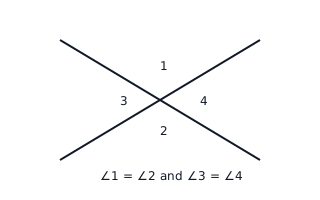
Vertically Opposite Angles: When two lines intersect, the angles formed opposite to each other at the vertex are called vertically opposite angles. They are always equal.
📐Formulae
💡Examples
Problem 1:
Find the measure of an angle which is equal to its complement.
Solution:
Let the angle be . Since it is equal to its complement:
Explanation:
If an angle is equal to its complement, their sum () must equal .
Problem 2:
Find the supplement of .
Solution:
To find the supplement, we subtract the given angle from : The supplement is .
Explanation:
Supplementary angles add up to . Subtracting from gives the remaining angle.
Problem 3:
In the given figure, two lines intersect. If one of the vertically opposite angles is , find the other three angles.
Solution:
Let the four angles be and . Let .
- (Vertically Opposite Angles are equal).
- (Linear Pair).
- .
- (Vertically Opposite Angles).
Explanation:
We use the property that vertically opposite angles are equal and adjacent angles on a straight line form a linear pair (sum to ).
Problem 4:
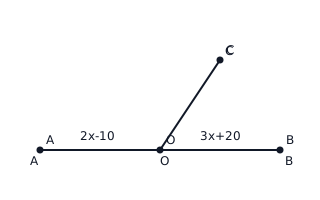
In the following figure, if and form a linear pair and the measure of and , find the value of .
Solution:
Since and form a linear pair, their sum must be .
Explanation:
We use the Linear Pair Property which states that the sum of adjacent angles on a straight line is . We set up an algebraic equation with the given expressions and solve for .
Problem 5:
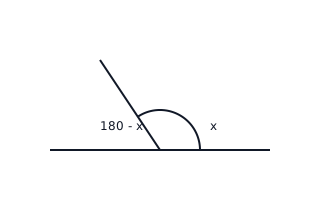
Find the angle which is double its supplement.
Solution:
Let the angle be . Then its supplement is . According to the problem: The angle is .
Explanation:
Supplementary angles add up to . By representing the angle as , we express the supplement in terms of and solve the resulting linear equation based on the given ratio.