
Review the key concepts, formulae, and examples before starting your quiz.
🔑Concepts
The protractor is a semi-circular mathematical tool used to measure angles in degrees from to . It has two scales: the inner scale (reading clockwise) and the outer scale (reading anti-clockwise).
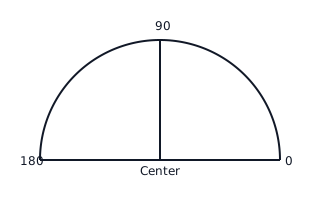
To measure an angle, place the center point of the protractor on the vertex of the angle and align the base line with one of the arms. The measure is read where the second arm crosses the scale.
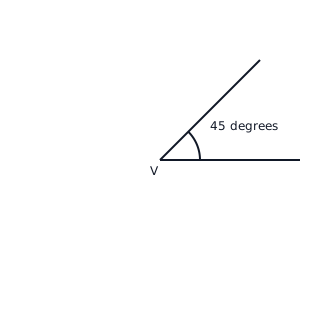
Angles are measured in units called degrees, denoted by the symbol . A full rotation is divided into equal parts, where each part is .
An angle can be seen as the amount of rotation of one ray around its endpoint to reach the position of another ray. For example, a revolution corresponds to .
📐Formulae
💡Examples
Problem 1:
Classify the following angles based on their measures: (a) (b) (c) (d) .
Solution:
(a) Acute angle, (b) Obtuse angle, (c) Reflex angle, (d) Right angle.
Explanation:
Since , it is acute. Since , it is obtuse. Since , it is reflex. is exactly a right angle.
Problem 2:
What fraction of a revolution is a right angle?
Solution:
Explanation:
A complete revolution is . A right angle is . The fraction is .
Problem 3:
If an angle is of a straight angle, what is its measure and type?
Solution:
, Right Angle
Explanation:
A straight angle is . Half of it is . An angle of is called a Right Angle.
Problem 4:
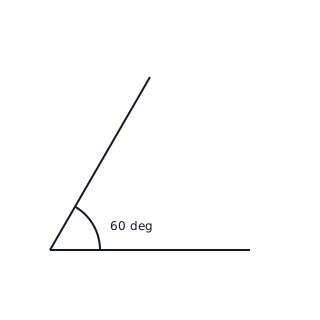
Identify the measure of the angle shown in the diagram and classify it as acute, obtuse, or right.
Solution:
, Acute Angle
Explanation:
By placing the protractor on the vertex, we see the ray passes through the mark. Since , the angle is classified as an acute angle.
Problem 5:
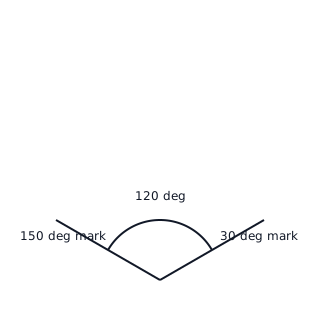
Calculate the angle between the two rays if one ray is at the mark and the other is at the mark on the same scale of a protractor.
Solution:
, Obtuse Angle
Explanation:
The measure of the angle between two rays is the difference between their positions on the scale: . Since is between and , it is an obtuse angle.