
Review the key concepts, formulae, and examples before starting your quiz.
🔑Concepts
Simultaneous equations represent two or more algebraic equations that share variables. The solution to the system is the set of values for the variables that satisfy all equations simultaneously. Graphically, this corresponds to the point(s) where the graphs of the equations intersect.
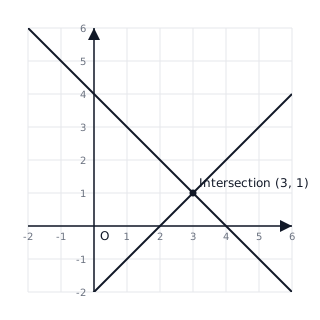
The Substitution Method involves rearranging one equation to express one variable in terms of the other (e.g., ) and then substituting this expression into the second equation to solve for a single variable.

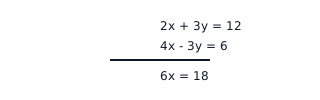
The Elimination Method is used by multiplying one or both equations by constants so that the coefficients of one variable are identical or opposites. Adding or subtracting the equations then 'eliminates' that variable.
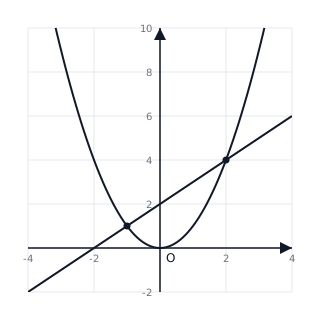
Non-linear systems involving one linear and one quadratic equation typically result in a quadratic equation after substitution. The number of solutions depends on the discriminant : two solutions (intersection), one solution (tangent), or no solutions (no intersection).
📐Formulae
Linear Equation Standard Form:
Slope-Intercept Form (useful for substitution):
Quadratic Form (common in non-linear systems):
The Discriminant (to check for number of intersections):
💡Examples
Problem 1:
Solve the simultaneous equations using elimination: and .
Solution:
- Multiply the second equation by 2: .
- Add this to the first equation: .
- Substitute into the second original equation: . Result: .
Explanation:
Elimination is most efficient here because doubling the second equation creates a term which cancels the in the first equation.
Problem 2:
Solve the simultaneous equations: and .
Solution:
- Set the equations equal to each other: .
- Rearrange into a quadratic: .
- Factorise: .
- Find x-values: or .
- Find corresponding y-values: If . If . Result: and .
Explanation:
When one equation is quadratic and the other is linear, use substitution. Setting the expressions for equal to each other allows you to solve for using quadratic methods (factorisation or the quadratic formula).
Problem 3:
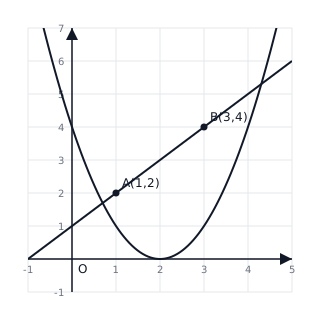
Solve the following simultaneous equations to find the coordinates where the line and curve meet:
Solution:
- Substitute the linear equation into the quadratic:
- Rearrange into standard quadratic form :
- Factorize the quadratic:
- Solve for :
- Substitute values back into : If If Solutions: and .
Explanation:
We equate the two expressions for to find the -coordinates of the intersection points. The resulting quadratic reveals two points of intersection.
Problem 4:
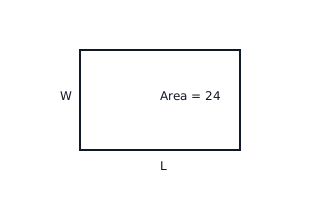
A rectangle has a perimeter of and an area of . Find the dimensions of the rectangle by setting up and solving simultaneous equations.
Solution:
Let length be and width be .
- Perimeter equation:
- Area equation:
- Substitute :
- Factorize:
- Solutions: The dimensions are and .
Explanation:
By defining variables for the dimensions, we create a linear equation from the perimeter and a non-linear equation from the area. Solving them reveals the length and width.