
Review the key concepts, formulae, and examples before starting your quiz.
🔑Concepts
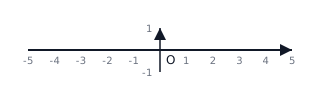
Linear inequalities involve comparing expressions using signs like , , , and . Solving a linear inequality is similar to solving an equation, except that when multiplying or dividing by a negative number, the direction of the inequality sign must be reversed.
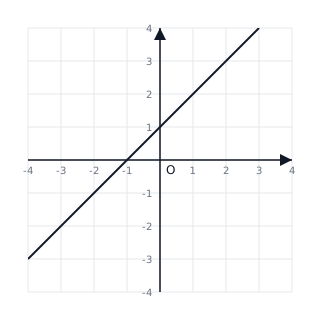
On a coordinate plane, the line acts as a boundary. Use a solid line for or (indicating the boundary is included) and a dashed/broken line for or (indicating the boundary is excluded).
The solution to a system of linear inequalities is the overlapping shaded region where all individual inequalities are satisfied simultaneously.
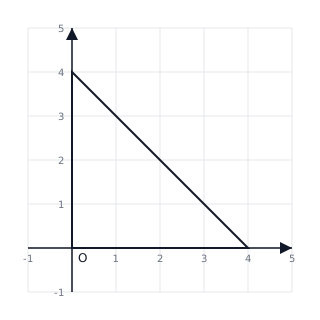
To identify the correct region, pick a test point not on the line (often ). If the point satisfies the inequality, shade the side containing that point. If not, shade the opposite side.
📐Formulae
💡Examples
Problem 1:
Solve the inequality: .
Solution:
Explanation:
Subtract 5 from both sides to get -2x ≤ 6. When dividing by -2, the inequality sign must be flipped from ≤ to ≥.
Problem 2:
Represent the region defined by on a graph.
Solution:
Draw the line as a solid line. Shade the area above the line.
Explanation:
The line is solid because of the 'equal to' part of the symbol (≥). Testing (0,0): results in , which is true, so the side containing the origin is shaded.
Problem 3:
Find the integer values of that satisfy: .
Solution:
. Integers: .
Explanation:
Subtract 1 from all parts of the inequality, then divide all parts by 2. The solution includes integers greater than -2 and up to (and including) 3.
Problem 4:
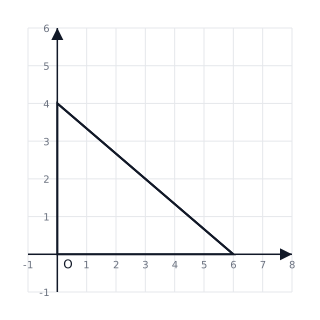
Identify the region on a graph that satisfies the inequality for the first quadrant ().
Solution:
- Find intercepts for the boundary line .
- If , . Point: .
- If , . Point: .
- Draw a dashed line through and because the inequality is strict ().
- Test : . This is true, so shade the region including the origin.
- Restrict to the first quadrant.
Explanation:
The boundary line intercepts the axes at and . Since it is a strict inequality, we use a dashed line and shade the area below it toward the origin.
Problem 5:
Solve the system of inequalities graphically and find the vertices of the enclosed region: , , and .
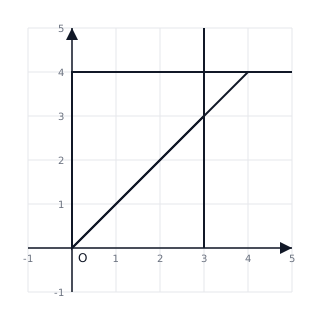
Solution:
- Plot (horizontal line). Shade below.
- Plot (vertical line). Shade to the left.
- Plot (diagonal line through origin). Shade above ().
- The intersection forms a triangle with vertices at , , and if we consider the y-axis, or if we use the given constraints. Vertices: , , , and .
Explanation:
The region is bounded by a horizontal line at , a vertical line at , and the identity line . The feasible region is the quadrilateral formed by these constraints in the positive quadrant.