
Review the key concepts, formulae, and examples before starting your quiz.
🔑Concepts
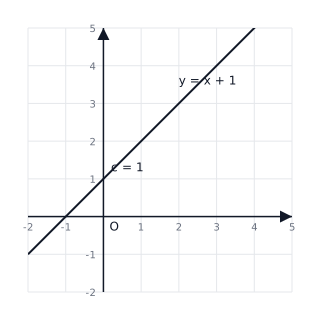
The gradient (slope) of a linear graph represents the rate of change. For a line , is the gradient and is the -intercept where the line crosses the -axis.
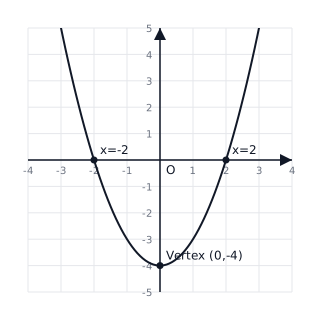
A quadratic graph forms a parabola. If , the parabola opens upwards (minimum point); if , it opens downwards (maximum point). The -intercepts are found by solving .
Solving simultaneous equations graphically involves finding the intersection point(s). A linear equation and a quadratic equation can intersect at zero, one, or two points.
The discriminant determines the nature of the roots of a quadratic equation. If , there are two distinct real roots (two -intercepts). If , there is one repeated real root (the graph touches the -axis). If , there are no real roots.
📐Formulae
(Gradient-intercept form)
(Gradient formula)
(The Quadratic Formula)
(Completed Square form)
(Vertex form of a quadratic graph)
💡Examples
Problem 1:
Solve the quadratic equation using the quadratic formula.
Solution:
. Therefore, or .
Explanation:
Identify . Substitute these into the quadratic formula. Simplify the discriminant () and solve for both the plus and minus cases.
Problem 2:
Solve the simultaneous equations: and .
Solution:
. Factorising gives , so or . When . When . Solutions: and .
Explanation:
Since both equations are equal to , set them equal to each other to form a single quadratic equation. Solve for , then substitute back into the linear equation to find the corresponding values.
Problem 3:
Find the coordinates of the turning point (vertex) of the graph by completing the square.
Solution:
. The vertex is .
Explanation:
Halve the coefficient of (which is ) to get for the bracket . Subtract the square of that number and add the constant. In the form , the vertex is .
Problem 4:
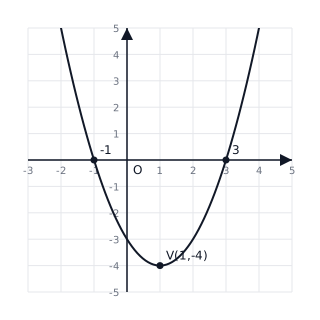
Solve the quadratic equation by factoring and sketch the graph of .
Solution:
- Factorize the quadratic:
- Solve for :
- Identify the -intercept: When .
- Find the vertex: . . Vertex is .
Explanation:
Factoring allows us to find the roots (x-intercepts) easily. The vertex is found using the axis of symmetry formula , which provides the minimum point for this upward-opening parabola.
Problem 5:
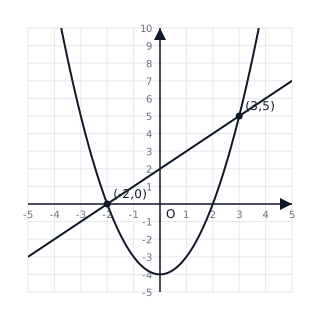
Determine the points of intersection for the linear equation and the quadratic equation . Sketch the graphs to verify your solution.
Solution:
- Set the equations equal to each other to find the -coordinates of the intersection points:
- Rearrange into a standard quadratic equation :
- Factorize the quadratic:
- Solve for :
- Substitute values back into the linear equation to find : If , . Point: If , . Point:
- The intersection points are and .
Explanation:
To find where a line and a curve meet, we solve them simultaneously. By setting the expressions for equal, we create a single quadratic equation in terms of . The solutions to this quadratic provide the -coordinates of the intersections. Substituting these into the simpler linear equation gives the corresponding -coordinates.