
Review the key concepts, formulae, and examples before starting your quiz.
🔑Concepts
Factorisation by taking out common factors: Identifying the highest common factor (HCF) of all terms in an expression. For example, in the expression , the HCF is .
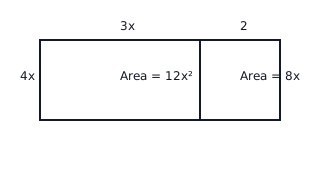
Factorising quadratics of the form : Find two numbers that multiply to give and add to give . These numbers form the factors .
Difference of two squares: Recognizing expressions in the form which always factorise to .
Simplifying algebraic fractions: Factorise both the numerator and the denominator completely, then cancel out common factors that appear in both.
Changing the subject of a formula: Using inverse operations to isolate a specific variable. If the variable appears twice, collect those terms on one side and factorise.
📐Formulae
Difference of Two Squares:
Perfect Square (Positive):
Perfect Square (Negative):
Quadratic Form: factorises to where and .
Algebraic Fraction Addition:
💡Examples
Problem 1:
Factorise completely: .
Solution:
Explanation:
Identify the Highest Common Factor (HCF) of the numerical coefficients (3) and the variables (). Divide each term by and place the result inside brackets.
Problem 2:
Simplify the algebraic fraction: .
Solution:
Explanation:
Factorise the numerator using the Difference of Two Squares: . Factorise the denominator: . Cancel the common factor from both the top and bottom.
Problem 3:
Make the subject of the formula: .
Solution:
Explanation:
- Multiply both sides by to get . 2. Expand: . 3. Move all terms to one side: . 4. Factorise : . 5. Divide by to isolate .
Problem 4:
Factorise by grouping: .
Solution:
Explanation:
Group the first two terms and the last two terms . Since is common to both groups, factorise it out to get .
Problem 5:
Calculate the area of the shaded region in terms of and factorise the resulting expression completely: a large square has side length and a smaller square of side length is removed from its center.
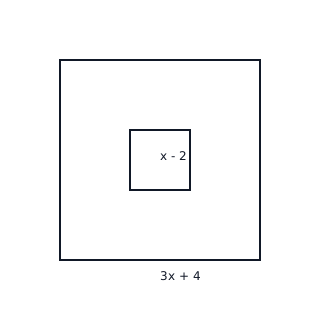
Solution:
Using : Factorise out common constants:
Explanation:
The problem uses the difference of two squares. We identify the side lengths as and , apply the identity, and then factor out constants from each binomial to factorise 'completely'.
Problem 6:
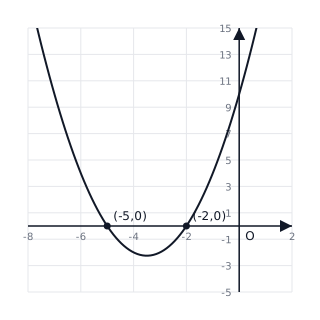
The area of a rectangle is represented by . If the width is , find an expression for the length. Use a graph of to identify the x-intercepts.
Solution:
Factorising the numerator: The x-intercepts occur where :
Explanation:
To find the length, we divide the area by the width. This requires factorising the quadratic expression. The factors and relate directly to the roots/x-intercepts of the function.