
Review the key concepts, formulae, and examples before starting your quiz.
🔑Concepts
The derivative represents the gradient (steepness) of a curve at any point. For a function , the value of the derivative at is the gradient of the tangent line touching the curve at that specific point.
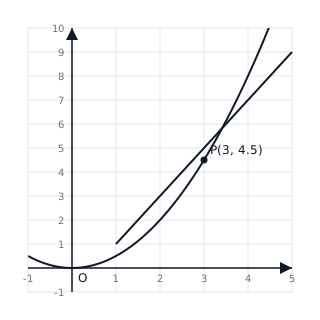
Power Rule for Differentiation: To differentiate a term of the form , multiply by the power and subtract 1 from the power: . Constants differentiate to zero because their 'steepness' is always zero.
Stationary points (turning points) occur where the gradient of the curve is zero (). At these points, the tangent line is perfectly horizontal.
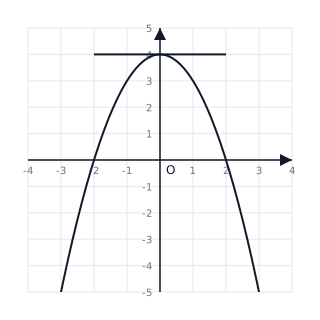
The second derivative (found by differentiating again) helps determine the nature of a stationary point: if it is a minimum; if it is a maximum.
📐Formulae
(where is a constant)
at
Equation of tangent:
💡Examples
Problem 1:
Differentiate with respect to .
Solution:
Explanation:
Apply the power rule to each term: , , the derivative of is , and the derivative of the constant is .
Problem 2:
Find the gradient of the curve at the point where .
Solution:
Explanation:
First, find the derivative: . To find the gradient at the specific point , substitute into the derivative: .
Problem 3:
Find the coordinates of the stationary point on the curve .
Solution:
Explanation:
- Find . 2. Set for stationary points: . 3. Substitute back into the original equation to find : .
Problem 4:
Find the equation of the tangent to the curve at the point where .
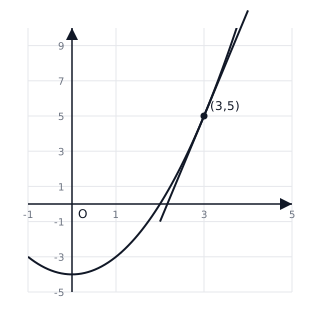
Solution:
-
Find the -coordinate when : Point is .
-
Find the derivative :
-
Calculate gradient at :
-
Use :
Explanation:
First find the point on the curve, then find the gradient function using differentiation. Substitute the -value to find the specific gradient and use the point-slope formula for the line.
Problem 5:
Identify the coordinates and nature of the stationary point for the function .
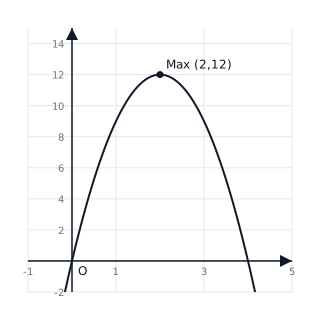
Solution:
-
Find :
-
Set for stationary points:
-
Find -coordinate: Point is .
-
Determine nature using : Since , the point is a Maximum.
Explanation:
Differentiate to find the gradient function. Solve for when the gradient is zero. Check the sign of the second derivative to classify the point as a maximum or minimum.