
Review the key concepts, formulae, and examples before starting your quiz.
🔑Concepts
A function maps an input to a unique output . Mapping diagrams visualize this relationship by showing how elements from the domain (input) relate to elements in the codomain (output). For , each input is shifted by .

The inverse function reverses the operation of . Graphically, the graph of is a reflection of in the line . If a point lies on , then lies on .
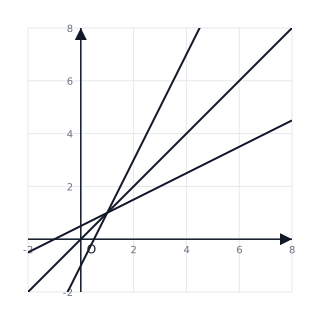
Composite functions like mean applying first, and then applying to the result. is shorthand for . The order is crucial: is generally not equal to .
To find the inverse algebraically: 1. Replace with . 2. Swap and . 3. Solve for the new . The resulting expression is .
📐Formulae
To find : 1. Let , 2. Swap and , 3. Rearrange to make the subject.
💡Examples
Problem 1:
Given and , find .
Solution:
- Find .
- Find .
Explanation:
To solve a composite function, evaluate the inner function first, then substitute that result into the outer function.
Problem 2:
Find the inverse function for .
Solution:
- Let .
- Swap and : .
- Multiply both sides: .
- Expand: .
- Group terms: .
- Factor out : .
- Solve for : .
- Therefore, .
Explanation:
To find an inverse, we treat as , swap variables to reverse the relationship, and use algebraic manipulation to isolate the new .
Problem 3:
If , solve the equation .
Solution:
- Find by setting : . So, .
- Set : .
- Solve for : .
Explanation:
Instead of finding the full expression for , you can use the property that if , then to find numerical values quickly.
Problem 4:
Given the function , find and sketch both functions on the same axes to show the reflection in .
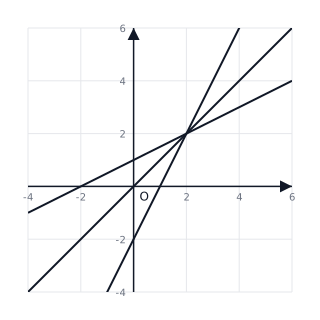
Solution:
Swap and : Subtract 1: Multiply by 2:
Explanation:
To find the inverse, we isolate the variable that was originally the input. The graph confirms that and are mirror images across the line .
Problem 5:
The function is defined for . Find the value of and illustrate the mapping.

Solution:
To find , we set : Since : So, .
Explanation:
An inverse function maps the output back to the input. For , the inverse operation for positive values is the square root.