
Review the key concepts, formulae, and examples before starting your quiz.
🔑Concepts
Vertical translations shift the graph up () or down (), while horizontal translations shift the graph right () or left ().
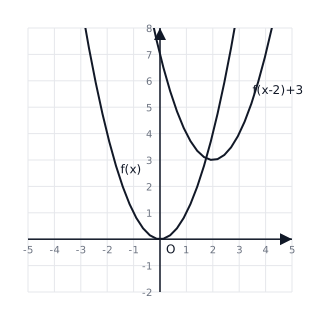
Vertical stretching pulls the graph away from the -axis by scale factor , whereas vertical compression occurs if . Reflection in the -axis is given by .
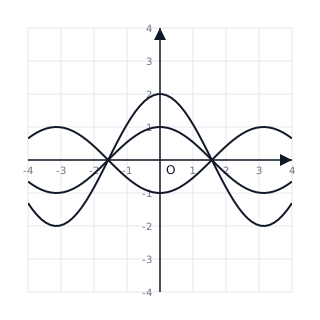
Horizontal stretching/compression uses a scale factor of . If , the graph is compressed towards the -axis; if , it is stretched away from the -axis.
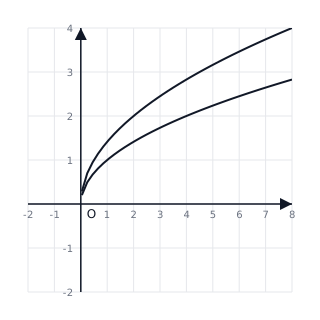
Reflection in the -axis is achieved by replacing with , resulting in the function . This maps points to .
📐Formulae
💡Examples
Problem 1:
The function is translated by the vector and then reflected in the -axis. Find the equation of the resulting function .
Solution:
Explanation:
Step 1: Apply the translation to , which gives , resulting in . Step 2: To reflect in the -axis, multiply the entire function by . This gives , which simplifies to .
Problem 2:
Describe the transformations required to transform the graph of into the graph of .
Solution:
- A horizontal stretch with a scale factor of . 2. A vertical stretch with a scale factor of .
Explanation:
The term inside the function represents a horizontal stretch by a factor of . The multiplier outside the function represents a vertical stretch by a scale factor of .
Problem 3:
The point lies on the graph of . Find the coordinates of the corresponding point on the graph of .
Solution:
Explanation:
First, handle the horizontal change: means we add to the -coordinate, so . Next, handle the vertical changes: the -coordinate is multiplied by and then is added. So, . The new point is .
Problem 4:
The graph of is transformed into the graph of . Sketch the graph of and identify the coordinates of its vertex.
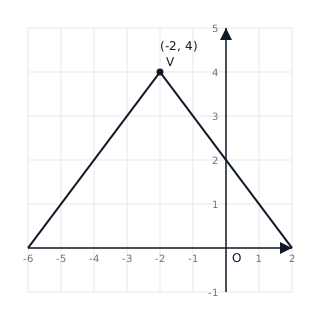
Solution:
- Start with , which has a vertex at .
- Shift left by units: , vertex at .
- Reflect in the -axis: , vertex remains at .
- Shift up by units: , vertex at . The resulting vertex is .
Explanation:
Multiple transformations are applied in sequence: horizontal translation, reflection, then vertical translation.
Problem 5:
Given , find the new function after a horizontal stretch with scale factor followed by a reflection in the -axis.
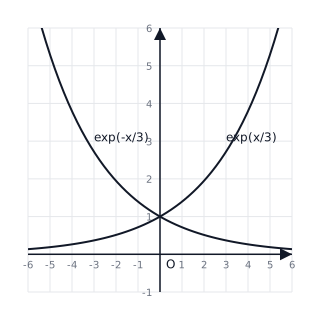
Solution:
- Horizontal stretch by scale factor means . The function becomes .
- Reflection in the -axis replaces with . The function becomes .
Explanation:
The horizontal stretch uses the reciprocal of the scale factor inside the function argument, and the reflection negates the variable.