
Review the key concepts, formulae, and examples before starting your quiz.
🔑Concepts
Composition of functions is the process of combining two or more functions where the output of one function becomes the input for the next. The notation represents , meaning is evaluated first, then the result is substituted into .
The domain of is the set of all in the domain of such that is in the domain of . This 'double-filtering' process ensures that the inner function produces a valid input for the outer function.
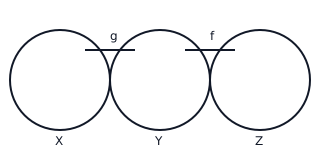
Composition is not commutative in general, meaning . The order of operations is critical: the function closest to the variable is applied first.
Composition with an identity function or an inverse: A function composed with its inverse results in the identity function, , effectively 'undoing' the operation.
📐Formulae
💡Examples
Problem 1:
Given and , find and .
Solution:
Explanation:
To find , substitute the entire expression for into every in . To find , substitute the expression for into every in .
Problem 2:
Let and . Determine the expression for and state its domain.
Solution:
Domain: For to be defined, . For the fraction to be defined, the denominator cannot be zero, so . Combining these, the domain is .
Explanation:
The domain is restricted by the inner function (which requires ) and the outer function (which prevents the denominator from being zero at ).
Problem 3:
If , find the value of such that .
Solution:
First, find : Set the expression equal to :
Explanation:
Find the composite function first by substituting the function into itself, then solve the resulting linear equation for .
Problem 4:
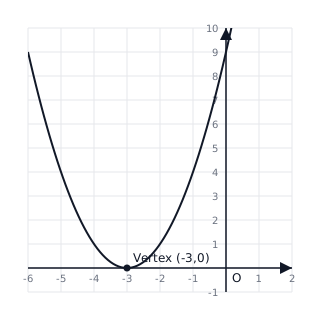
Given the functions and , find the composite function and identify the coordinate of the vertex of .
Solution:
- Write the composite expression:
- Substitute into :
- Expand the expression (optional):
- Identify the vertex: Since the function is in the form , where and , the vertex is at .
Explanation:
This example demonstrates how a horizontal translation shifts the base function to the left by 3 units before the squaring operation occurs.
Problem 5:
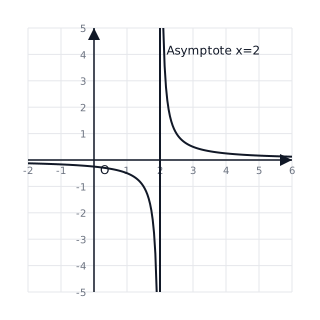
If and , find the domain of .
Solution:
- Express the composite function: .
- Determine the restriction: The denominator of a fraction cannot be zero.
- Solve which gives .
- State the domain: .
Explanation:
The domain of a composite function must exclude values that make the inner function undefined (none here) and values where the output of the inner function is not in the domain of the outer function (where ).