
Review the key concepts, formulae, and examples before starting your quiz.
🔑Concepts
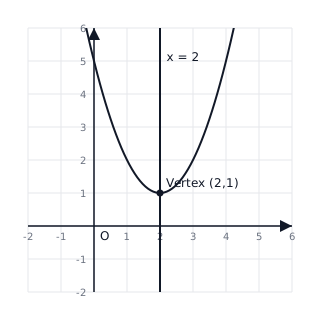
The vertex of a quadratic function represents the maximum or minimum point. The vertical line (where ) is the axis of symmetry, dividing the parabola into two mirror-image halves.
The discriminant determines the number of -intercepts (roots). If , there are two distinct real roots; if , there is one repeated real root (the vertex touches the -axis); if , there are no real roots.
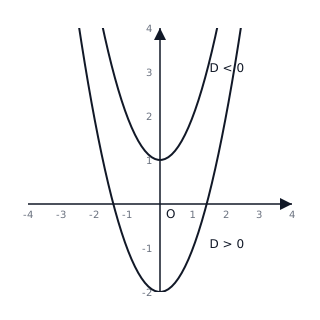
The sign of the leading coefficient determines the concavity. If , the parabola opens upwards (concave up) and has a minimum. If , the parabola opens downwards (concave down) and has a maximum.
The -intercept of the function is found at in the standard form .
📐Formulae
💡Examples
Problem 1:
Given the function , express the function in vertex form and state the coordinates of the vertex.
Solution:
The vertex is .
Explanation:
To convert to vertex form, we complete the square. Factor out the leading coefficient from the terms, then add and subtract inside the parentheses.
Problem 2:
Find the range of values for such that the equation has no real roots.
Solution:
For no real roots, the discriminant must be less than zero:
Explanation:
The nature of the roots is determined by the discriminant . No real roots occur when the value inside the square root of the quadratic formula is negative.
Problem 3:
A parabola has -intercepts at and , and passes through the point . Find the equation of the function in the form .
Solution:
Using factored form : Substitute : Expand to general form:
Explanation:
Start with the factored form since the roots are given. Substitute the third known point to find the leading coefficient , then expand the brackets to reach the general form.
Problem 4:
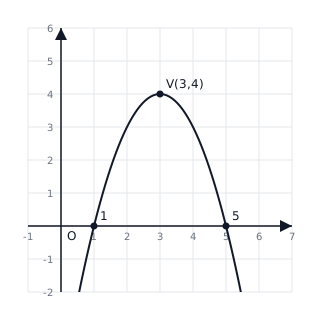
Identify the coordinates of the -intercepts and the vertex for the function . Sketch the graph.
Solution:
- The -intercepts are found by setting . From , we get and .
- The -coordinate of the vertex () is the midpoint of the intercepts: .
- Substitute into the function to find the -coordinate (): .
- The vertex is . Since , the parabola opens downwards.
Explanation:
Using the factored form allows us to immediately identify the roots and . The axis of symmetry always lies exactly halfway between these roots.
Problem 5:
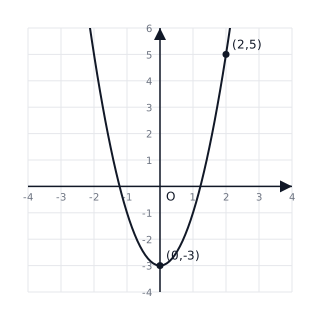
Determine the equation of the quadratic function shown in the diagram, which has a vertex at and passes through the point .
Solution:
- Start with the vertex form . Given vertex , and .
- The equation is , or .
- Use the point to solve for : .
- .
- The final equation is .
Explanation:
When the vertex is on the -axis, the function simplifies to the form . We use a known point on the curve to calculate the vertical stretch factor .