krit.club logo

Functions - Polynomial functions

Grade 11IB_AA

Review the key concepts, formulae, and examples before starting your quiz.

πŸ”‘Concepts

β€’

A polynomial function of degree nn is defined by the expression P(x)=anxn+anβˆ’1xnβˆ’1+β‹―+a1x+a0P(x) = a_n x^n + a_{n-1} x^{n-1} + \dots + a_1 x + a_0, where anβ‰ 0a_n \neq 0. The degree determines the maximum number of real roots and the maximum number of turning points (nβˆ’1n-1).

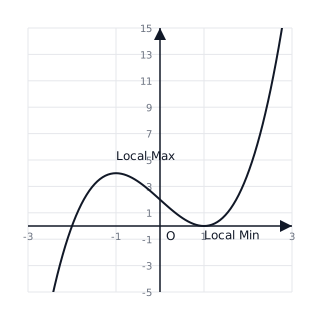
Graph of a cubic polynomial showing turning points and intercepts.
β€’

The Factor Theorem states that (xβˆ’c)(x - c) is a factor of P(x)P(x) if and only if P(c)=0P(c) = 0. This link between algebraic factors and xx-intercepts is fundamental for sketching graphs and solving higher-degree equations.
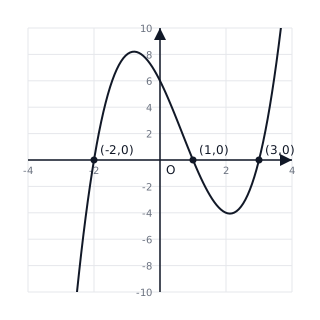
Cubic graph crossing the x-axis at -2, 1, and 3.
β€’

The multiplicity of a root determines the behavior of the graph at the xx-intercept. A root of multiplicity 1 crosses the axis linearly, multiplicity 2 (even) touches the axis and turns back (tangent), and multiplicity 3 (odd) creates a horizontal point of inflection.
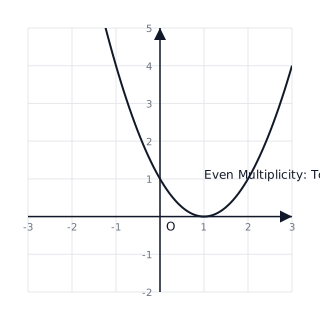
Graph of y = (x-1)^2 showing a bounce at x=1.
β€’

End behavior is determined by the leading term anxna_n x^n. If nn is even and an>0a_n > 0, yβ†’βˆžy \to \infty as xβ†’Β±βˆžx \to \pm \infty. If nn is odd and an>0a_n > 0, yβ†’βˆžy \to \infty as xβ†’βˆžx \to \infty and yβ†’βˆ’βˆžy \to -\infty as xβ†’βˆ’βˆžx \to -\infty.

πŸ“Formulae

P(x)=anxn+anβˆ’1xnβˆ’1+β‹―+a1x+a0P(x) = a_n x^n + a_{n-1} x^{n-1} + \dots + a_1 x + a_0

P(x)=a(xβˆ’r1)(xβˆ’r2)…(xβˆ’rn)P(x) = a(x - r_1)(x - r_2)\dots(x - r_n)

P(c)=RΒ (RemainderΒ Theorem)P(c) = R \text{ (Remainder Theorem)}

P(c)=0β€…β€ŠβŸΊβ€…β€Š(xβˆ’c)Β isΒ aΒ factorP(c) = 0 \iff (x - c) \text{ is a factor}

x=βˆ’bΒ±b2βˆ’4ac2aΒ (forΒ degreeΒ 2Β factors)x = \frac{-b \pm \sqrt{b^2 - 4ac}}{2a} \text{ (for degree 2 factors)}

πŸ’‘Examples

Problem 1:

Given that P(x)=2x3+ax2βˆ’5x+6P(x) = 2x^3 + ax^2 - 5x + 6, find the value of aa if the remainder when P(x)P(x) is divided by (xβˆ’2)(x - 2) is 1212.

Solution:

Using the Remainder Theorem, P(2)=12P(2) = 12. Substitute x=2x = 2 into the polynomial: 2(2)3+a(2)2βˆ’5(2)+6=122(2)^3 + a(2)^2 - 5(2) + 6 = 12 2(8)+4aβˆ’10+6=122(8) + 4a - 10 + 6 = 12 16+4aβˆ’4=1216 + 4a - 4 = 12 12+4a=1212 + 4a = 12 4a=04a = 0 a=0a = 0

Explanation:

The Remainder Theorem states that P(c)P(c) gives the remainder when P(x)P(x) is divided by (xβˆ’c)(x-c). Setting P(2)=12P(2) = 12 allows us to solve for the unknown coefficient aa.

Problem 2:

Show that (x+3)(x + 3) is a factor of P(x)=x3+2x2βˆ’5xβˆ’6P(x) = x^3 + 2x^2 - 5x - 6, and hence factorize P(x)P(x) completely.

Solution:

First, test if P(βˆ’3)=0P(-3) = 0: P(βˆ’3)=(βˆ’3)3+2(βˆ’3)2βˆ’5(βˆ’3)βˆ’6P(-3) = (-3)^3 + 2(-3)^2 - 5(-3) - 6 P(βˆ’3)=βˆ’27+2(9)+15βˆ’6P(-3) = -27 + 2(9) + 15 - 6 P(βˆ’3)=βˆ’27+18+15βˆ’6=0P(-3) = -27 + 18 + 15 - 6 = 0 Since P(βˆ’3)=0P(-3) = 0, (x+3)(x + 3) is a factor. Perform polynomial division or synthetic division to find the quotient: (x3+2x2βˆ’5xβˆ’6)=(x+3)(x2βˆ’xβˆ’2)(x^3 + 2x^2 - 5x - 6) = (x + 3)(x^2 - x - 2) Factor the quadratic part: x2βˆ’xβˆ’2=(xβˆ’2)(x+1)x^2 - x - 2 = (x - 2)(x + 1) So, P(x)=(x+3)(xβˆ’2)(x+1)P(x) = (x + 3)(x - 2)(x + 1).

Explanation:

The Factor Theorem confirms (x+3)(x+3) is a factor. Dividing the cubic by the linear factor results in a quadratic, which can then be factored using standard methods.

Problem 3:

Sketch the graph of f(x)=βˆ’(xβˆ’1)2(x+2)f(x) = -(x - 1)^2(x + 2). Identify intercepts and end behavior.

Solution:

  1. Intercepts:
  • xx-intercepts: Set f(x)=0β€…β€ŠβŸΉβ€…β€Šx=1f(x) = 0 \implies x = 1 (multiplicity 2) and x=βˆ’2x = -2 (multiplicity 1).
  • yy-intercept: f(0)=βˆ’(0βˆ’1)2(0+2)=βˆ’(1)(2)=βˆ’2f(0) = -(0 - 1)^2(0 + 2) = -(1)(2) = -2.
  1. End Behavior:
  • The leading term is βˆ’x3-x^3 (degree 3, negative leading coefficient).
  • As xβ†’βˆž,f(x)β†’βˆ’βˆžx \to \infty, f(x) \to -\infty.
  • As xβ†’βˆ’βˆž,f(x)β†’βˆžx \to -\infty, f(x) \to \infty.
  1. Shape:
  • At x=1x = 1, the graph touches the xx-axis (turning point).
  • At x=βˆ’2x = -2, the graph crosses the xx-axis.

Explanation:

Roots provide the xx-intercepts. The multiplicity tells us whether the graph crosses or turns at the axis. The leading term determines the behavior of the 'tails' of the graph.

Problem 4:

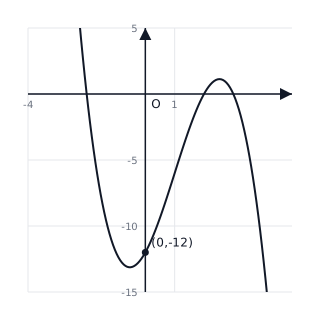
Determine the equation of the polynomial function f(x)f(x) of degree 3 shown in the diagram, given it has a yy-intercept at (0,βˆ’12)(0, -12) and xx-intercepts at x=βˆ’2,2,3x = -2, 2, 3.

Graph of a cubic function passing through (-2,0), (2,0), (3,0) and (0,-12).

Solution:

  1. Write the general factored form: f(x)=a(x+2)(xβˆ’2)(xβˆ’3)f(x) = a(x + 2)(x - 2)(x - 3).
  2. Use the yy-intercept (0,βˆ’12)(0, -12) to find aa: βˆ’12=a(0+2)(0βˆ’2)(0βˆ’3)-12 = a(0 + 2)(0 - 2)(0 - 3) βˆ’12=a(2)(βˆ’2)(βˆ’3)-12 = a(2)(-2)(-3) βˆ’12=12a-12 = 12a a=βˆ’1a = -1
  3. Therefore, f(x)=βˆ’(x+2)(xβˆ’2)(xβˆ’3)f(x) = -(x + 2)(x - 2)(x - 3).
  4. Expanding gives f(x)=βˆ’(x2βˆ’4)(xβˆ’3)=βˆ’(x3βˆ’3x2βˆ’4x+12)=βˆ’x3+3x2+4xβˆ’12f(x) = -(x^2 - 4)(x - 3) = -(x^3 - 3x^2 - 4x + 12) = -x^3 + 3x^2 + 4x - 12.

Explanation:

Identify the roots from the graph to set up the factored form, then solve for the vertical stretch factor using the given point.

Problem 5:

Sketch the graph of g(x)=(xβˆ’1)2(x+2)g(x) = (x-1)^2(x+2) and find the coordinates of the intercepts.
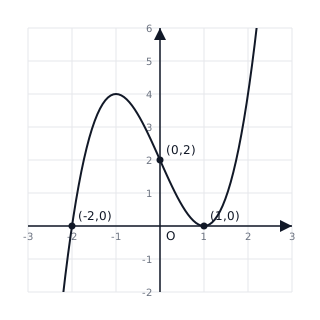
Graph of g(x) showing a bounce at (1,0) and crossing at (-2,0).

Solution:

  1. xx-intercepts: Set g(x)=0g(x) = 0. Roots are x=1x = 1 (multiplicity 2) and x=βˆ’2x = -2 (multiplicity 1).
  2. yy-intercept: g(0)=(0βˆ’1)2(0+2)=1Γ—2=2g(0) = (0-1)^2(0+2) = 1 \times 2 = 2. Intercept is (0,2)(0, 2).
  3. Behavior: At x=1x=1, the graph touches the axis (parabolic shape). At x=βˆ’2x=-2, it crosses. Leading term is x3x^3, so end behavior is yβ†’βˆžy \to \infty as xβ†’βˆžx \to \infty and yβ†’βˆ’βˆžy \to -\infty as xβ†’βˆ’βˆžx \to -\infty.

Explanation:

The multiplicity of (xβˆ’1)2(x-1)^2 means the graph is tangent to the x-axis at x=1x=1.