krit.club logo

Functions - Exponential equations

Grade 11IB_AA

Review the key concepts, formulae, and examples before starting your quiz.

πŸ”‘Concepts

β€’

The fundamental property used to solve exponential equations is the one-to-one property: if ax=aya^x = a^y (where a>0,a≠1a > 0, a \neq 1), then x=yx = y. This allows us to solve equations by expressing both sides with a common base.
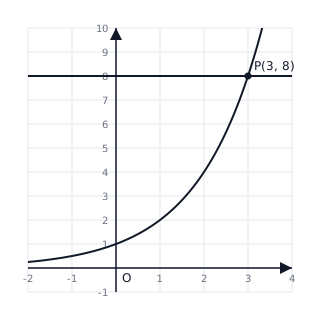
Graph showing the intersection of y = 2^x and y = 8 at x = 3.
β€’

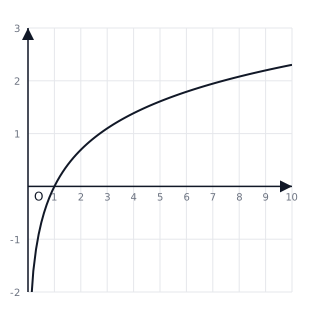
When bases cannot be easily equated, logarithms are used. For ax=ba^x = b, we take the natural logarithm of both sides to get ln⁑(ax)=ln⁑(b)\ln(a^x) = \ln(b), which simplifies to xln⁑a=ln⁑bx \ln a = \ln b, and finally x=ln⁑bln⁑ax = \frac{\ln b}{\ln a}.

Graph of the natural logarithm function.
β€’

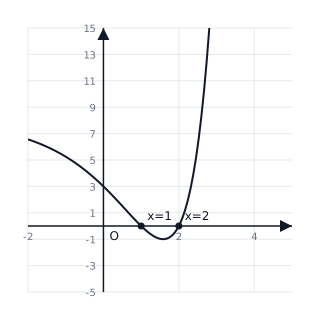
Some exponential equations are quadratic in form, such as a(kx)2+b(kx)+c=0a(k^x)^2 + b(k^x) + c = 0. These can be solved by substituting u=kxu = k^x, solving for uu, and then solving the resulting exponential equations for xx.

Graph of a function quadratic in terms of 2^x showing roots.
β€’

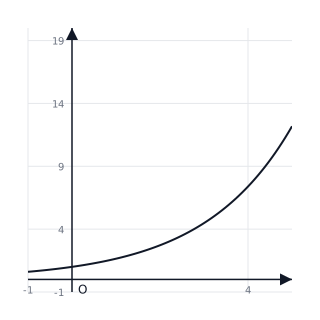
Natural exponential equations involve the base eβ‰ˆ2.718e \approx 2.718. The equation ex=ke^x = k is solved directly as x=ln⁑kx = \ln k. Growth and decay models often use f(t)=A0ektf(t) = A_0 e^{kt}.

Graph of natural exponential growth.

πŸ“Formulae

amΓ—an=am+na^m \times a^n = a^{m+n}

aman=amβˆ’n\frac{a^m}{a^n} = a^{m-n}

(am)n=amn(a^m)^n = a^{mn}

aβˆ’n=1ana^{-n} = \frac{1}{a^n}

amn=amna^{\frac{m}{n}} = \sqrt[n]{a^m}

If ax=b, then x=ln⁑bln⁑a\text{If } a^x = b, \text{ then } x = \frac{\ln b}{\ln a}

f(t)=A0ektf(t) = A_0 e^{kt}

πŸ’‘Examples

Problem 1:

Solve for xx: 32xβˆ’1=273^{2x-1} = 27

Solution:

32xβˆ’1=333^{2x-1} = 3^3 2xβˆ’1=32x - 1 = 3 2x=42x = 4 x=2x = 2

Explanation:

Since 2727 can be written as 333^3, we can equate the exponents because the bases are now the same.

Problem 2:

Solve for xx: 5x=125^x = 12, giving your answer to 3 significant figures.

Solution:

ln⁑(5x)=ln⁑(12)\ln(5^x) = \ln(12) xln⁑5=ln⁑12x \ln 5 = \ln 12 x=ln⁑12ln⁑5x = \frac{\ln 12}{\ln 5} xβ‰ˆ1.54x \approx 1.54

Explanation:

Since the bases cannot be made the same easily, we take the natural logarithm of both sides and use the power rule to isolate xx.

Problem 3:

Solve the equation 4xβˆ’6(2x)+8=04^x - 6(2^x) + 8 = 0.

Solution:

Let u=2xu = 2^x. Then 4x=(22)x=(2x)2=u24^x = (2^2)^x = (2^x)^2 = u^2. u2βˆ’6u+8=0u^2 - 6u + 8 = 0 (uβˆ’4)(uβˆ’2)=0(u - 4)(u - 2) = 0 u=4Β orΒ u=2u = 4 \text{ or } u = 2 Substituting back u=2xu = 2^x: 2x=4β€…β€ŠβŸΉβ€…β€Šx=22^x = 4 \implies x = 2 2x=2β€…β€ŠβŸΉβ€…β€Šx=12^x = 2 \implies x = 1

Explanation:

This is an equation in quadratic form. By substituting u=2xu = 2^x, we transform it into a standard quadratic equation, solve for uu, and then solve for xx.

Problem 4:

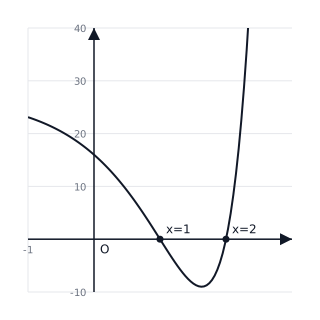
Solve for xx: 9xβˆ’12(3x)+27=09^x - 12(3^x) + 27 = 0.

Graph of y = 9^x - 12(3^x) + 27 showing x-intercepts at 1 and 2.

Solution:

  1. Rewrite the equation using a common base: (32)xβˆ’12(3x)+27=0(3^2)^x - 12(3^x) + 27 = 0.
  2. Use the power rule: (3x)2βˆ’12(3x)+27=0(3^x)^2 - 12(3^x) + 27 = 0.
  3. Let u=3xu = 3^x. The equation becomes u2βˆ’12u+27=0u^2 - 12u + 27 = 0.
  4. Factor the quadratic: (uβˆ’3)(uβˆ’9)=0(u - 3)(u - 9) = 0.
  5. Solve for uu: u=3u = 3 or u=9u = 9.
  6. Substitute back: 3x=33^x = 3 or 3x=93^x = 9.
  7. Solving these gives x=1x = 1 or x=2x = 2.

Explanation:

This is a quadratic-type exponential equation. By substituting u=3xu = 3^x, we transform a transcendental equation into a manageable algebraic one.

Problem 5:

Find the value of xx such that 2x+1=7x2^{x+1} = 7^{x}, giving your answer to 3 decimal places.
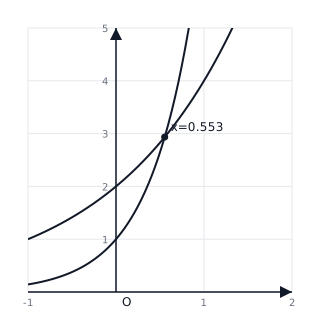
Graph showing the intersection of y = 2^(x+1) and y = 7^x at approximately x = 0.553.

Solution:

  1. Take the natural logarithm of both sides: ln⁑(2x+1)=ln⁑(7x)\ln(2^{x+1}) = \ln(7^x).
  2. Use the power property: (x+1)ln⁑2=xln⁑7(x+1)\ln 2 = x \ln 7.
  3. Expand the left side: xln⁑2+ln⁑2=xln⁑7x \ln 2 + \ln 2 = x \ln 7.
  4. Rearrange to isolate xx: ln⁑2=xln⁑7βˆ’xln⁑2\ln 2 = x \ln 7 - x \ln 2.
  5. Factor out xx: ln⁑2=x(ln⁑7βˆ’ln⁑2)\ln 2 = x(\ln 7 - \ln 2).
  6. Solve for xx: x=ln⁑2ln⁑7βˆ’ln⁑2x = \frac{\ln 2}{\ln 7 - \ln 2}.
  7. Calculate: xβ‰ˆ0.553x \approx 0.553.

Explanation:

Since the bases 2 and 7 cannot be written as powers of a common integer base, we use logarithms to isolate the variable in the exponent.

Exponential equations Grade 11 Notes & Examples