
Review the key concepts, formulae, and examples before starting your quiz.
🔑Concepts
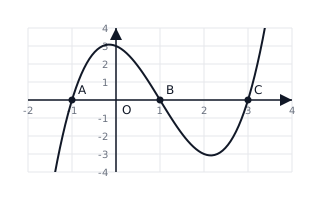
The fundamental method for solving polynomial inequalities or involves finding the real roots (zeros) of the polynomial. These roots divide the number line into intervals. Within each interval, the polynomial maintains a constant sign (either positive or negative). Testing a value from each interval or using the leading coefficient and multiplicity of roots helps determine the sign.
Rational inequalities of the form are solved by finding both the zeros of the numerator (where the expression equals zero) and the zeros of the denominator (where the expression is undefined). These critical values are plotted on a number line to create test intervals.
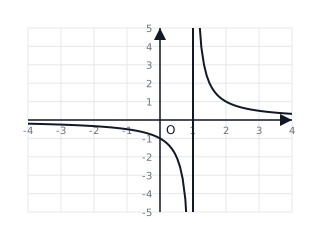
When solving rational inequalities, never cross-multiply by a variable expression because the sign of that expression (positive or negative) is unknown. Instead, move all terms to one side to get zero on the other, then find a common denominator: .

The multiplicity of a root affects how the graph behaves at the x-axis. If a factor has an even exponent , the graph touches the axis and turns back (no sign change). If is odd, the graph crosses the axis (sign change occurs). This rule applies to both polynomial roots and vertical asymptotes in rational functions.
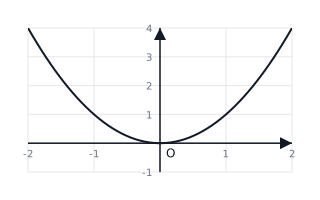
Final solutions must strictly exclude values that make the denominator zero. In non-strict inequalities ( or ), the roots of the numerator are included (solid circles/square brackets), but the roots of the denominator are always excluded (open circles/parentheses).
📐Formulae
💡Examples
Problem 1:
Solve the polynomial inequality: .
Solution:
- Factor the quadratic: .
- Find the critical values by setting the expression to zero: and .
- Test the intervals:
- For (e.g., ): (True)
- For (e.g., ): (False)
- For (e.g., ): (True)
- The solution is or .
Explanation:
We factor the polynomial to find the points where the function crosses the x-axis. We then check the sign of the product in the regions defined by these points to see where it is positive.
Problem 2:
Solve the rational inequality: .
Solution:
- Move all terms to one side:
- Find a common denominator:
- Identify critical values: Zeros are (numerator) and (denominator).
- Note: because the denominator cannot be zero.
- Test intervals:
- : (True)
- : (False)
- : (True)
- Solution: or .
Explanation:
We avoid cross-multiplying by because its sign depends on . Instead, we subtract 2 from both sides, simplify into a single fraction, and analyze the signs of the numerator and denominator.
Problem 3:
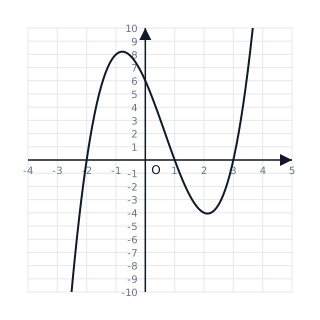
Solve the polynomial inequality: .
Solution:
- Identify the zeros: , , and .
- Create a sign chart. Test intervals:
- Interval : Try (Negative)
- Interval : Try (Positive)
- Interval : Try (Negative)
- Interval : Try (Positive)
- We seek values .
- Solution: .
Explanation:
The inequality is satisfied when the product of the factors is negative or zero. The zeros divide the x-axis into four segments, and we check the sign in each.
Problem 4:
Solve the rational inequality: .
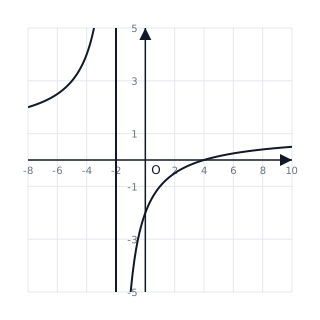
Solution:
- Find critical points: Numerator zero at ; Denominator zero at .
- Test intervals on the number line:
- : Try (Positive)
- : Try (Negative)
- : Try (Positive)
- Exclude (undefined) and (strict inequality).
- Solution: .
Explanation:
The sign of a fraction changes at the roots of the numerator and the roots of the denominator. Both types of critical points are treated as boundaries on the sign chart.