
Review the key concepts, formulae, and examples before starting your quiz.
🔑Concepts
A vertical asymptote occurs at a value where the function approaches infinity or negative infinity as approaches . For rational functions , this usually occurs at the roots of the denominator that are not also roots of the numerator.
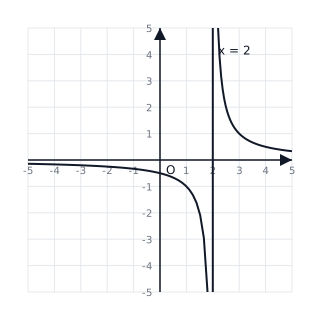
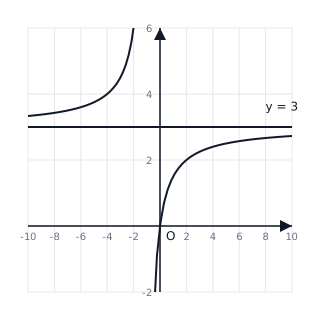
A horizontal asymptote describes the behavior of the function as approaches positive or negative infinity. For a rational function, if the degree of the numerator equals the degree of the denominator, the horizontal asymptote is the ratio of the leading coefficients.
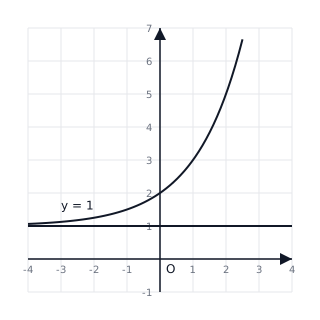
Exponential functions of the form always possess a horizontal asymptote at . As (for ), the term approaches zero, leaving the constant .
Logarithmic functions of the form have a vertical asymptote at . This is because the argument of a logarithm must be strictly positive (), so the function is undefined for .
📐Formulae
💡Examples
Problem 1:
Find the equations of the asymptotes for the function .
Solution:
- To find the Vertical Asymptote, set the denominator to zero: .
- To find the Horizontal Asymptote, look at the ratio of the leading coefficients: .
Explanation:
The vertical asymptote occurs where the function is undefined (denominator is zero). The horizontal asymptote is found by evaluating the limit as approaches infinity, which for linear-over-linear functions is the ratio of the coefficients.
Problem 2:
Determine the horizontal asymptote of .
Solution:
As , the term . Therefore, . The horizontal asymptote is .
Explanation:
For exponential functions , the horizontal asymptote is always because the exponential part approaches zero in one direction of .
Problem 3:
Find the vertical asymptote of the function .
Solution:
The argument of a logarithm must be greater than zero. The vertical asymptote occurs where the argument equals zero: .
Explanation:
Logarithmic functions are undefined for values that make the inner argument zero or negative; the boundary of this domain is the vertical asymptote.
Problem 4:
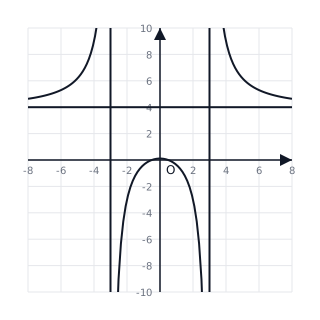
Identify the equations of the vertical and horizontal asymptotes for the function .
Solution:
- Vertical Asymptotes: Set the denominator to zero: . Thus, and are vertical asymptotes.
- Horizontal Asymptote: Compare the degrees of the numerator and denominator. Both are degree 2. The horizontal asymptote is the ratio of the leading coefficients: .
Explanation:
Vertical asymptotes occur where the denominator is zero. Horizontal asymptotes are found by looking at the limit as goes to infinity, which for equal-degree polynomials is the ratio of coefficients.
Problem 5:
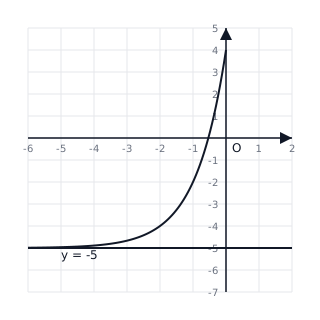
Find the asymptote of the function .
Solution:
The function is an exponential function of the form .
- As , .
- Therefore, .
- The horizontal asymptote is .
Explanation:
Exponential functions have a single horizontal asymptote. The vertical shift of the parent function determines the position of this asymptote.