
Review the key concepts, formulae, and examples before starting your quiz.
🔑Concepts
The modulus function, denoted by , represents the absolute value or magnitude of a number. Geometrically, it is the distance of from the origin on a number line. The graph of is created by reflecting the parts of the graph that lie below the -axis (where ) into the -axis.
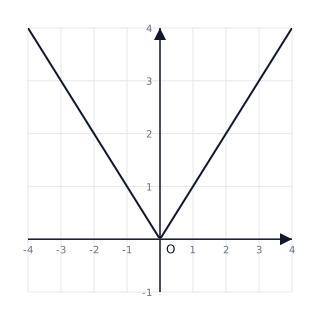
To solve equations of the form , consider two cases: or . It is critical to check for extraneous solutions by substituting results back into the original equation, as the modulus must always be non-negative ().
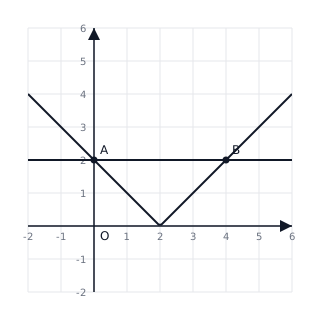
Modulus inequalities of the form can be solved efficiently by squaring both sides, since both sides are non-negative. This leads to the inequality , which can then be rearranged and solved using factorisation or quadratic methods.
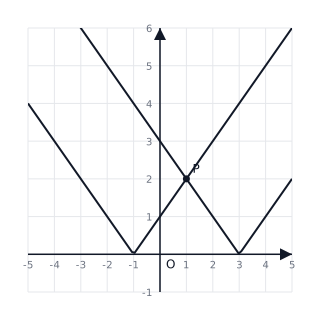
The composite function is obtained by taking the part of the graph for and reflecting it across the -axis. This ensures the function is even, meaning .
📐Formulae
💡Examples
Problem 1:
Solve the equation .
Solution:
Case 1: . Check: ; RHS: . (Valid) Case 2: . Check: ; RHS: . (Valid) Final solutions: .
Explanation:
We split the modulus into its positive and negative cases. Each result must be substituted back into the original equation to ensure the right-hand side is not negative, which would make the equality impossible.
Problem 2:
Solve the inequality .
Solution:
Since both sides are non-negative, square both sides: Solve the quadratic equation using the quadratic formula or factoring: . Test intervals for : If , . (True) If , . (False) If , . (True) Solution: or .
Explanation:
Squaring is the most efficient algebraic method for inequalities involving two modulus expressions. After squaring, we solve the resulting quadratic inequality by finding the roots and testing intervals.
Problem 3:
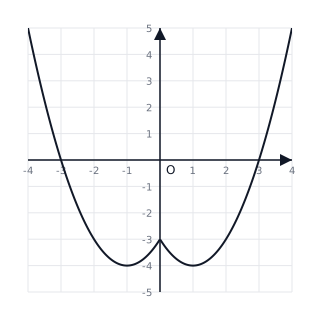
Sketch the graph of . Find the values of for which has exactly 3 solutions.
Solution:
- Start with (a parabola with vertex and roots ).
- Apply the modulus: Reflect the portion between and (where is negative) across the -axis. The new vertex is .
- To have exactly 3 solutions, the horizontal line must intersect the graph at exactly 3 points. Looking at the graph, the line passes through the local maximum and two other points on the outer arms of the parabola. Therefore, .
Explanation:
Graphical analysis is often required in IB HL. By reflecting the negative parts of the parabola, we see a 'W' shaped curve. The line intersects the 'peaks' or 'troughs' to change the number of solutions.
Problem 4:
Solve the equation analytically and verify the solution graphically.
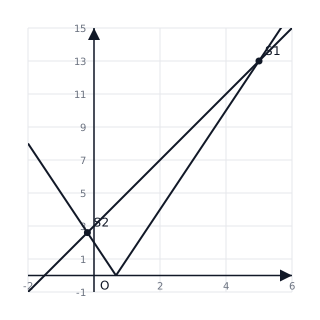
Solution:
-
Set up the two cases: Case 1: Case 2:
-
Check validity: For : ; . Valid. For : ; . Valid.
The solutions are and .
Explanation:
To solve a modulus equation, we branch into the positive and negative possibilities of the expression inside the modulus. Each solution must be checked against the right-hand side function to ensure it doesn't result in a negative value, which is impossible for a modulus output.
Problem 5:
Solve the inequality algebraically and illustrate the solution on a graph.
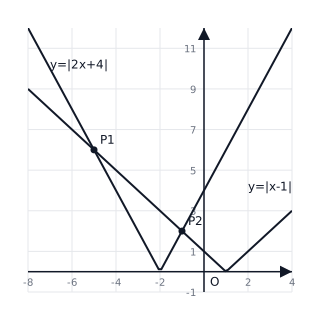
Solution:
- To solve , we square both sides (since both sides are non-negative):
- Expand the expressions:
- Rearrange into a quadratic inequality:
- Divide by 3:
- Factor the quadratic:
- Find the critical values: and . Testing intervals or observing the upward-opening parabola, the expression is non-negative when:
Thus, the solution set is .
Explanation:
Squaring both sides is an effective method for inequalities involving two absolute values because . The resulting quadratic inequality defines the regions where the distance of from is greater than or equal to the distance of from . The graph shows the intersections of the two V-shaped functions at and .