
Straight Lines - Various Forms of the Equation of a Line: Horizontal/Vertical, Point-Slope, Two-Point, Slope-Intercept, Intercept Form
Review the key concepts, formulae, and examples before starting your quiz.
🔑Concepts
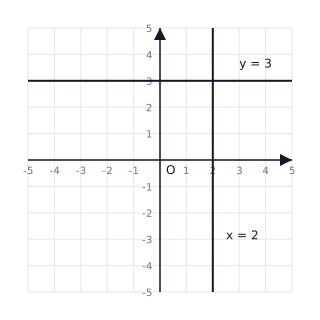
The Horizontal Line equation is given by , where is the -coordinate of any point on the line. Similarly, a Vertical Line is given by , where is the -coordinate of any point on the line.
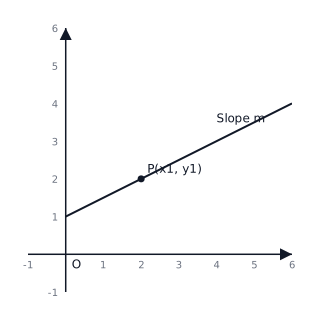
The Point-Slope Form is used when the slope and one point on the line are known.
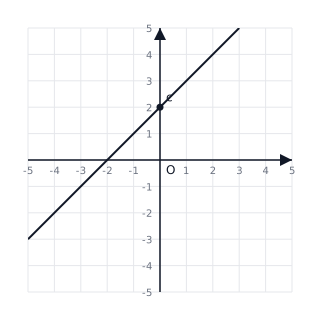
The Slope-Intercept Form represents a line with slope and -intercept (the point where the line crosses the -axis).
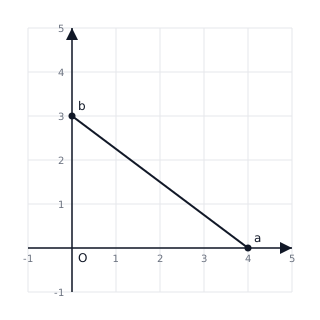
The Intercept Form is used when the -intercept and -intercept are given.
📐Formulae
Horizontal Line:
Vertical Line:
Slope-Intercept Form:
Point-Slope Form:
Two-Point Form:
Slope () from two points:
Slope () from inclination:
💡Examples
Problem 1:
Find the equation of the line passing through the point with a slope of .
Solution:
- Identify the given values: and .
- Use the Point-Slope form: .
- Substitute the values: .
- Simplify: .
- Rearrange into general form: .
Explanation:
We use the point-slope form because we are given one specific point and the gradient of the line.
Problem 2:
Find the equation of the line that cuts off intercepts and on the x and y axes respectively.
Solution:
- Identify the intercepts: (x-intercept) and (y-intercept).
- Use the Intercept form: .
- Substitute the values: .
- Find the common denominator to simplify: .
- Final equation: or .
Explanation:
The intercept form is the most direct method here as it utilizes the points and where the line crosses the axes.
Problem 3:
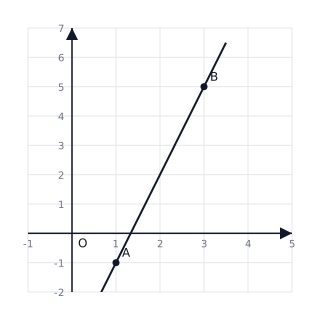
Find the equation of the line passing through the points and .
Solution:
- Find the slope :
- Use the Two-Point Form (or Point-Slope Form with point ):
Explanation:
We first calculate the slope of the line using the two given points. Then, we substitute the slope and one of the points into the point-slope equation to find the general linear equation.
Problem 4:
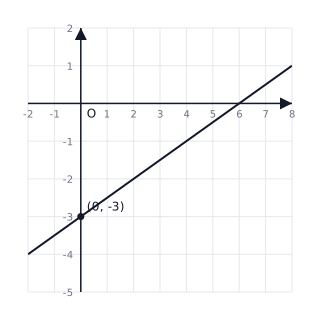
Determine the equation of a line that has a slope of and a -intercept of .
Solution:
- Identify the given values: Slope and -intercept .
- Substitute into the Slope-Intercept Form :
- Convert to general form:
Explanation:
Since the slope and the -intercept are directly provided, the slope-intercept form is the most efficient method to derive the equation.