krit.club logo

Straight Lines - General Equation of a Line

Grade 11CBSE

Review the key concepts, formulae, and examples before starting your quiz.

🔑Concepts

•

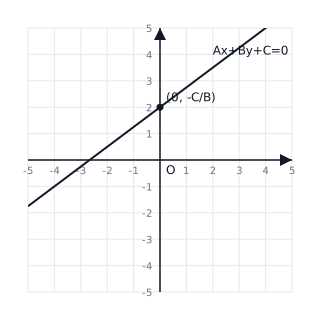
The General Equation of a line is expressed as Ax+By+C=0Ax + By + C = 0, where A,B,CA, B, C are constants. By rearranging this to y=−ABx−CBy = -\frac{A}{B}x -\frac{C}{B}, we identify the slope m=−ABm = -\frac{A}{B} and the y-intercept c=−CBc = -\frac{C}{B}.

Graph of a general line equation showing the y-intercept.
•

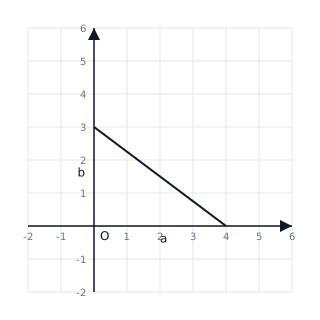
The intercept form is xa+yb=1\frac{x}{a} + \frac{y}{b} = 1. We convert Ax+By+C=0Ax + By + C = 0 to this form by moving CC to the RHS and dividing by −C-C, yielding a=−CAa = -\frac{C}{A} and b=−CBb = -\frac{C}{B}.

Line showing x-intercept 'a' and y-intercept 'b'.
•

Distance from a point (x1,y1)(x_1, y_1) to a line Ax+By+C=0Ax + By + C = 0 is the length of the perpendicular segment from the point to the line.
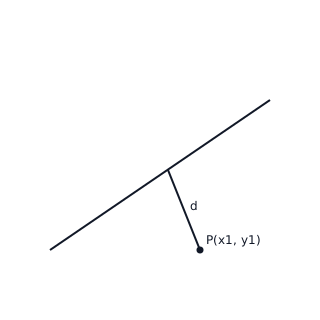
Perpendicular distance from a point to a line.
•

The normal form of a line is xcos⁡α+ysin⁡α=px \cos \alpha + y \sin \alpha = p, where pp is the perpendicular distance from the origin and α\alpha is the angle made by the normal with the positive x-axis.

📐Formulae

General Form: Ax+By+C=0Ax + By + C = 0

Slope (mm): m=−ABm = -\frac{A}{B}

Y-intercept (cc): c=−CBc = -\frac{C}{B}

X-intercept (aa): a=−CAa = -\frac{C}{A}

Normal Form conversion: cos⁡α=±AA2+B2\cos \alpha = \pm \frac{A}{\sqrt{A^2+B^2}}, sin⁡α=±BA2+B2\sin \alpha = \pm \frac{B}{\sqrt{A^2+B^2}}, p=∣C∣A2+B2p = \frac{|C|}{\sqrt{A^2+B^2}}

Distance from (x1,y1)(x_1, y_1) to Ax+By+C=0Ax + By + C = 0: d=∣Ax1+By1+C∣A2+B2d = \frac{|Ax_1 + By_1 + C|}{\sqrt{A^2 + B^2}}

Distance between parallel lines Ax+By+C1=0Ax + By + C_1 = 0 and Ax+By+C2=0Ax + By + C_2 = 0: d=∣C1−C2∣A2+B2d = \frac{|C_1 - C_2|}{\sqrt{A^2 + B^2}}

💡Examples

Problem 1:

Reduce the equation 3x−4y+10=03x - 4y + 10 = 0 to slope-intercept form and find its slope and y-intercept.

Solution:

  1. Given the equation: 3x−4y+10=03x - 4y + 10 = 0.
  2. Isolate the yy term: −4y=−3x−10-4y = -3x - 10.
  3. Divide by −4-4: y=−3−4x−10−4y = \frac{-3}{-4}x - \frac{10}{-4}.
  4. Simplify: y=34x+52y = \frac{3}{4}x + \frac{5}{2}.
  5. Comparing with y=mx+cy = mx + c, we get m=34m = \frac{3}{4} and c=52c = \frac{5}{2}.

Explanation:

To find the slope and y-intercept, we rearrange the general linear equation into the slope-intercept form y=mx+cy = mx + c by solving for yy.

Problem 2:

Find the distance between the parallel lines 3x−4y+7=03x - 4y + 7 = 0 and 3x−4y+5=03x - 4y + 5 = 0.

Solution:

  1. Identify coefficients: A=3,B=−4,C1=7,C2=5A = 3, B = -4, C_1 = 7, C_2 = 5.
  2. Use the formula for distance between parallel lines: d=∣C1−C2∣A2+B2d = \frac{|C_1 - C_2|}{\sqrt{A^2 + B^2}}.
  3. Substitute the values: d=∣7−5∣32+(−4)2d = \frac{|7 - 5|}{\sqrt{3^2 + (-4)^2}}.
  4. Calculate the denominator: 9+16=25=5\sqrt{9 + 16} = \sqrt{25} = 5.
  5. Calculate the numerator: ∣2∣=2|2| = 2.
  6. Result: d=25d = \frac{2}{5} units.

Explanation:

Since the coefficients of xx and yy are identical in both equations, the lines are parallel. We apply the specific formula for the distance between parallel lines using their constant terms.

Problem 3:

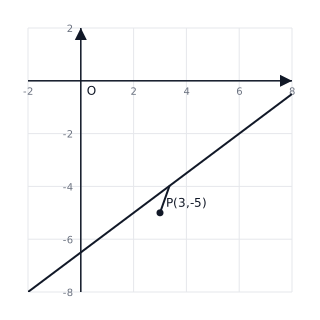
Find the distance of the point (3,−5)(3, -5) from the line 3x−4y−26=03x - 4y - 26 = 0.

Point P(3,-5) and its distance to the line 3x - 4y - 26 = 0.

Solution:

  1. Identify A=3A=3, B=−4B=-4, C=−26C=-26 and point (x1,y1)=(3,−5)(x_1, y_1) = (3, -5).
  2. Use formula: d=∣Ax1+By1+C∣A2+B2d = \frac{|Ax_1 + By_1 + C|}{\sqrt{A^2 + B^2}}.
  3. Substitute values: d=∣3(3)+(−4)(−5)−26∣32+(−4)2d = \frac{|3(3) + (-4)(-5) - 26|}{\sqrt{3^2 + (-4)^2}}.
  4. d=∣9+20−26∣9+16=∣3∣5=0.6d = \frac{|9 + 20 - 26|}{\sqrt{9 + 16}} = \frac{|3|}{5} = 0.6 units.

Explanation:

The distance is found by substituting the point coordinates into the general equation and dividing by the magnitude of the normal vector (A,B)(A, B).

Problem 4:

Reduce the equation 3x+y−8=0\sqrt{3}x + y - 8 = 0 into normal form. Find the values of pp and ω\omega. Also, find the distance of this line from the origin.
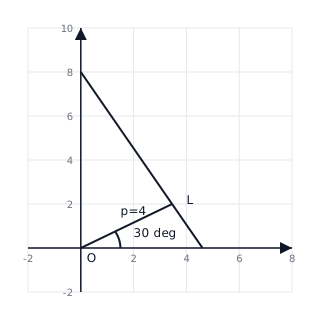
Normal form of a line showing the perpendicular distance p from origin and angle omega with the x-axis.

Solution:

Given equation: 3x+y=8\sqrt{3}x + y = 8 Divide both sides by (3)2+12=3+1=2\sqrt{(\sqrt{3})^2 + 1^2} = \sqrt{3+1} = 2: 32x+12y=82\frac{\sqrt{3}}{2}x + \frac{1}{2}y = \frac{8}{2} 32x+12y=4\frac{\sqrt{3}}{2}x + \frac{1}{2}y = 4 Comparing with xcos⁡ω+ysin⁡ω=px \cos \omega + y \sin \omega = p: cos⁡ω=32\cos \omega = \frac{\sqrt{3}}{2}, sin⁡ω=12\sin \omega = \frac{1}{2}, and p=4p = 4. Since both sin⁡ω\sin \omega and cos⁡ω\cos \omega are positive, ω\omega lies in the first quadrant. ω=30∘\omega = 30^{\circ} or π6\frac{\pi}{6}. The distance from the origin is p=4p = 4 units.

Explanation:

To reduce the general form Ax+By+C=0Ax + By + C = 0 to normal form, we divide the entire equation by A2+B2\sqrt{A^2 + B^2}. We ensure the constant term pp is positive by adjusting the signs of the coefficients if necessary. The resulting coefficients of xx and yy represent cos⁡ω\cos \omega and sin⁡ω\sin \omega respectively.