
Review the key concepts, formulae, and examples before starting your quiz.
🔑Concepts
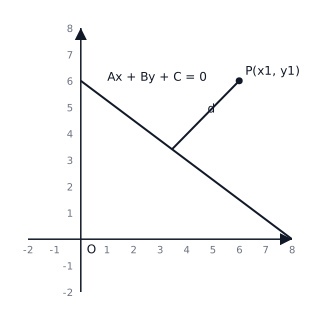
The distance from a point to a line is the length of the perpendicular segment dropped from the point to the line.
Distance of the origin from a line is the perpendicular distance calculated by substituting and into the distance formula.
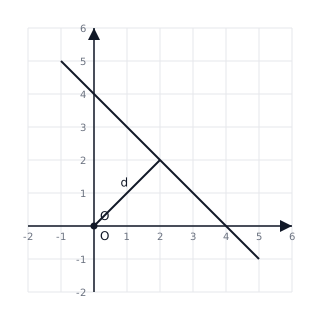
Parallel lines have the same slope. The distance between two parallel lines is constant and is measured along a perpendicular transversing both lines.
To find the distance between parallel lines, we ensure both equations are in the form with identical and coefficients.
📐Formulae
The distance of a point from the line is given by:
The distance of the origin from the line is:
The distance between two parallel lines and is:
The distance between two parallel lines in slope-intercept form and is:
💡Examples
Problem 1:
Find the distance of the point from the line .
Solution:
- Identify the values from the point and the line equation: , , , , and .
- Substitute these values into the distance formula:
- Simplify the numerator:
- Simplify the denominator:
- Calculate the final distance:
Explanation:
We use the standard distance formula for a point to a line. The absolute value ensures the distance is positive, and the denominator represents the magnitude of the normal vector to the line.
Problem 2:
Find the distance between the parallel lines and .
Solution:
- Identify the coefficients: , , , and .
- Use the formula for distance between parallel lines:
- Substitute the values:
- Simplify the numerator:
- Simplify the denominator:
- Calculate the final result:
Explanation:
Since the and coefficients are the same for both lines, they are parallel. The distance between them is the difference in their constants divided by the square root of the sum of the squares of the coefficients.
Problem 3:
Find the distance of the point from the line .
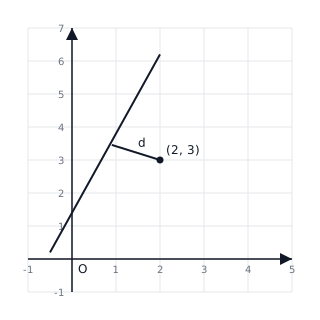
Solution:
- Identify coordinates and coefficients: .
- Apply the formula: .
- Substitute values: .
- Calculate: . Distance is units.
Explanation:
We substitute the point into the general equation of the line and divide by the magnitude of the normal vector .
Problem 4:
Determine the distance between the parallel lines and .
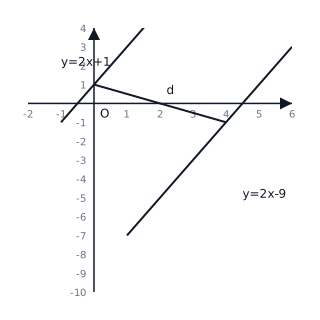
Solution:
- The lines are in slope-intercept form where .
- Use the formula: .
- Substitute: .
- Calculate: . Distance is units.
Explanation:
Since the slopes are identical, we find the vertical gap between the y-intercepts and adjust for the tilt of the lines.