krit.club logo

Straight Lines - Conditions for parallelism and perpendicularity of lines

Grade 11CBSE

Review the key concepts, formulae, and examples before starting your quiz.

🔑Concepts

•

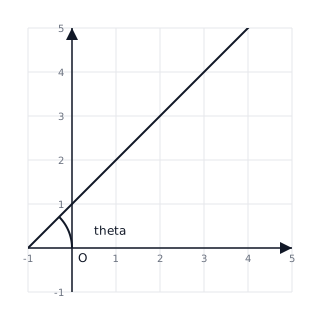
The slope of a line, denoted by mm, is defined as m=tan⁡θm = \tan \theta, where θ\theta is the angle of inclination with the positive direction of the xx-axis. For a line passing through (x1,y1)(x_1, y_1) and (x2,y2)(x_2, y_2), m=y2−y1x2−x1m = \frac{y_2 - y_1}{x_2 - x_1}.

A line intersecting the x-axis at an angle theta representing the slope.
•

Two non-vertical lines L1L_1 and L2L_2 are parallel if and only if their slopes are equal, i.e., m1=m2m_1 = m_2. Visually, these lines maintain a constant distance and never intersect.
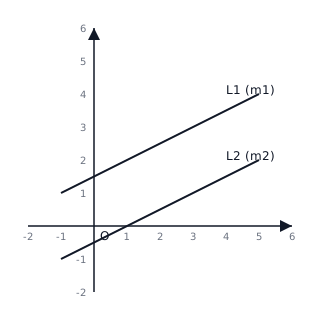
Two parallel lines with equal slopes.
•

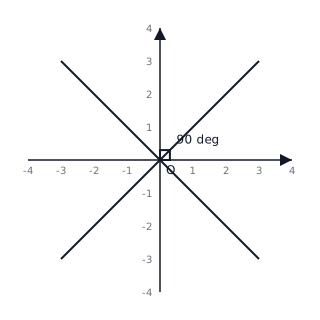
Two non-vertical lines L1L_1 and L2L_2 are perpendicular if and only if the product of their slopes is −1-1, i.e., m1⋅m2=−1m_1 \cdot m_2 = -1. This implies m2=−1m1m_2 = -\frac{1}{m_1}.

Two perpendicular lines intersecting at 90 degrees.
•

For a line in general form Ax+By+C=0Ax + By + C = 0, the slope is m=−ABm = -\frac{A}{B}. For parallel lines, the coefficients AA and BB remain in the same ratio, while for perpendicular lines, the coefficients are swapped and one sign is changed (e.g., Bx−Ay+λ=0Bx - Ay + \lambda = 0).

📐Formulae

m=tan⁡θm = \tan \theta

m=y2−y1x2−x1m = \frac{y_2 - y_1}{x_2 - x_1}

m1=m2 (Condition for parallel lines)m_1 = m_2 \text{ (Condition for parallel lines)}

m1⋅m2=−1 (Condition for perpendicular lines)m_1 \cdot m_2 = -1 \text{ (Condition for perpendicular lines)}

m=−Coefficient of xCoefficient of ym = -\frac{\text{Coefficient of } x}{\text{Coefficient of } y}

💡Examples

Problem 1:

Check whether the line passing through the points (2,−3)(2, -3) and (−5,1)(-5, 1) is parallel to the line passing through (7,−1)(7, -1) and (0,3)(0, 3).

Solution:

Slope of the first line (m1m_1) = 1−(−3)−5−2=4−7=−47\frac{1 - (-3)}{-5 - 2} = \frac{4}{-7} = -\frac{4}{7}. Slope of the second line (m2m_2) = 3−(−1)0−7=4−7=−47\frac{3 - (-1)}{0 - 7} = \frac{4}{-7} = -\frac{4}{7}. Since m1=m2m_1 = m_2, the lines are parallel.

Explanation:

Two lines are parallel if their slopes are equal. We calculate the slope using the formula m=y2−y1x2−x1m = \frac{y_2 - y_1}{x_2 - x_1} for both pairs of points and compare them.

Problem 2:

Find the equation of a line passing through the point (−2,3)(-2, 3) and perpendicular to the line 3x−4y+8=03x - 4y + 8 = 0.

Solution:

The given line is 3x−4y+8=03x - 4y + 8 = 0. Rewriting in slope-intercept form: 4y=3x+8⇒y=34x+24y = 3x + 8 \Rightarrow y = \frac{3}{4}x + 2. Thus, slope m1=34m_1 = \frac{3}{4}. For a perpendicular line, m1⋅m2=−1m_1 \cdot m_2 = -1, so m2=−1m1=−43m_2 = -\frac{1}{m_1} = -\frac{4}{3}. Using point-slope form: y−3=−43(x−(−2))⇒3(y−3)=−4(x+2)⇒3y−9=−4x−8⇒4x+3y−1=0y - 3 = -\frac{4}{3}(x - (-2)) \Rightarrow 3(y - 3) = -4(x + 2) \Rightarrow 3y - 9 = -4x - 8 \Rightarrow 4x + 3y - 1 = 0.

Explanation:

First, identify the slope of the given line. Then, use the perpendicularity condition m1m2=−1m_1 m_2 = -1 to find the slope of the required line. Finally, use the point-slope formula y−y1=m(x−x1)y - y_1 = m(x - x_1) to derive the equation.

Problem 3:

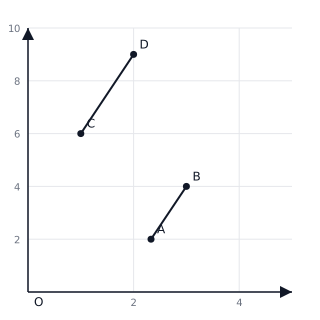
Find the value of xx such that the line through (x,2)(x, 2) and (3,4)(3, 4) is parallel to the line through (1,6)(1, 6) and (2,9)(2, 9).

Graph showing two parallel line segments AB and CD.

Solution:

  1. Find slope m1m_1 of the first line: m1=4−23−x=23−xm_1 = \frac{4 - 2}{3 - x} = \frac{2}{3 - x}.
  2. Find slope m2m_2 of the second line: m2=9−62−1=31=3m_2 = \frac{9 - 6}{2 - 1} = \frac{3}{1} = 3.
  3. Since lines are parallel, m1=m2m_1 = m_2.
  4. 23−x=3  ⟹  2=3(3−x)  ⟹  2=9−3x\frac{2}{3 - x} = 3 \implies 2 = 3(3 - x) \implies 2 = 9 - 3x.
  5. 3x=7  ⟹  x=733x = 7 \implies x = \frac{7}{3}.

Explanation:

Parallel lines must have the same gradient. By calculating the slopes using the coordinate formula and setting them equal, we can solve for the unknown coordinate.

Problem 4:

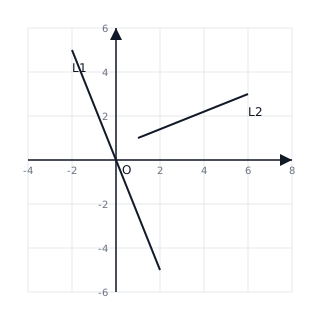
Show that the line joining the points (2,−5)(2, -5) and (−2,5)(-2, 5) is perpendicular to the line joining (6,3)(6, 3) and (1,1)(1, 1).

Two lines L1 and L2 intersecting at a right angle.

Solution:

  1. Let m1m_1 be the slope of the line through (2,−5)(2, -5) and (−2,5)(-2, 5): m1=5−(−5)−2−2=10−4=−52m_1 = \frac{5 - (-5)}{-2 - 2} = \frac{10}{-4} = -\frac{5}{2}.
  2. Let m2m_2 be the slope of the line through (6,3)(6, 3) and (1,1)(1, 1): m2=1−31−6=−2−5=25m_2 = \frac{1 - 3}{1 - 6} = \frac{-2}{-5} = \frac{2}{5}.
  3. Calculate the product: m1⋅m2=(−52)⋅(25)=−1m_1 \cdot m_2 = (-\frac{5}{2}) \cdot (\frac{2}{5}) = -1.
  4. Since the product of slopes is −1-1, the lines are perpendicular.

Explanation:

If the product of the slopes of two lines is −1-1, the lines are perpendicular to each other.