krit.club logo

Straight Lines - Angle between two lines

Grade 11CBSE

Review the key concepts, formulae, and examples before starting your quiz.

πŸ”‘Concepts

β€’

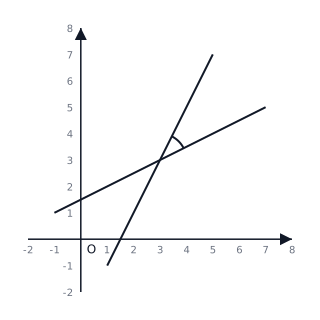
The angle ΞΈ\theta between two non-vertical lines L1L_1 and L2L_2 with slopes m1m_1 and m2m_2 is given by tan⁑θ=∣m2βˆ’m11+m1m2∣\tan \theta = \left| \frac{m_2 - m_1}{1 + m_1 m_2} \right|. This formula yields the acute angle between the lines; the obtuse angle is 180βˆ˜βˆ’ΞΈ180^\circ - \theta.

Intersection of two lines L1 and L2 showing the acute angle theta between them.
β€’

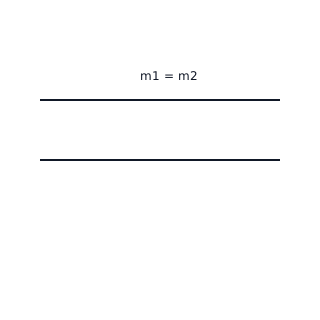
Two lines are parallel if and only if their slopes are equal, i.e., m1=m2m_1 = m_2. In this case, tan⁑θ=0\tan \theta = 0, so θ=0∘\theta = 0^\circ.

Two parallel horizontal lines indicating equal slopes.
β€’

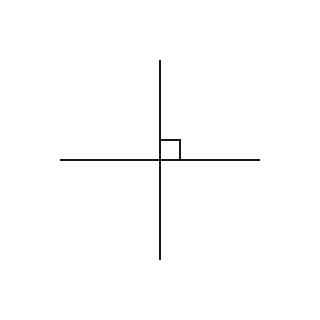
Two lines are perpendicular if and only if the product of their slopes is βˆ’1-1, i.e., m1m2=βˆ’1m_1 m_2 = -1. This occurs when the angle between them is 90∘90^\circ.

Two lines intersecting at a 90 degree angle.
β€’

If one line is vertical (x=cx = c), its slope is undefined. If the other line has slope mm, the angle ΞΈ\theta is found using tan⁑(90βˆ˜βˆ’Ξ±)=1m\tan(90^\circ - \alpha) = \frac{1}{m}, where Ξ±\alpha is the inclination of the second line.

πŸ“Formulae

tan⁑θ=∣m2βˆ’m11+m1m2∣\tan \theta = \left| \frac{m_2 - m_1}{1 + m_1 m_2} \right|

m1=m2β€…β€ŠβŸΉβ€…β€ŠL1βˆ₯L2m_1 = m_2 \implies L_1 \parallel L_2

m1m2=βˆ’1β€…β€ŠβŸΉβ€…β€ŠL1βŠ₯L2m_1 m_2 = -1 \implies L_1 \perp L_2

m=βˆ’ABΒ (SlopeΒ ofΒ lineΒ Ax+By+C=0)m = -\frac{A}{B} \text{ (Slope of line } Ax + By + C = 0)

πŸ’‘Examples

Problem 1:

Find the angle between the lines yβˆ’3xβˆ’5=0y - \sqrt{3}x - 5 = 0 and 3yβˆ’x+6=0\sqrt{3}y - x + 6 = 0.

Solution:

First, find the slopes of the lines. For the first line y=3x+5y = \sqrt{3}x + 5, the slope m1=3m_1 = \sqrt{3}. For the second line 3y=xβˆ’6\sqrt{3}y = x - 6, which is y=13xβˆ’63y = \frac{1}{\sqrt{3}}x - \frac{6}{\sqrt{3}}, the slope m2=13m_2 = \frac{1}{\sqrt{3}}. Using the formula: tan⁑θ=∣13βˆ’31+(3)(13)∣\tan \theta = \left| \frac{\frac{1}{\sqrt{3}} - \sqrt{3}}{1 + (\sqrt{3})(\frac{1}{\sqrt{3}})} \right| tan⁑θ=∣1βˆ’331+1∣=βˆ£βˆ’223∣=13\tan \theta = \left| \frac{\frac{1-3}{\sqrt{3}}}{1 + 1} \right| = \left| \frac{-2}{2\sqrt{3}} \right| = \frac{1}{\sqrt{3}} Since tan⁑θ=13\tan \theta = \frac{1}{\sqrt{3}}, the acute angle ΞΈ=30∘\theta = 30^\circ.

Explanation:

Slopes are extracted by converting the equations to y=mx+cy = mx + c form. The tangent formula provides the value for the acute angle between the two slopes.

Problem 2:

If the angle between two lines is Ο€4\frac{\pi}{4} and the slope of one of the lines is 12\frac{1}{2}, find the slope of the other line.

Solution:

Let the slope of the first line be m1=12m_1 = \frac{1}{2} and the slope of the second line be m2=mm_2 = m. The angle ΞΈ=Ο€4\theta = \frac{\pi}{4}, so tan⁑θ=tan⁑π4=1\tan \theta = \tan \frac{\pi}{4} = 1. Using the formula: 1=∣mβˆ’121+m2∣1 = \left| \frac{m - \frac{1}{2}}{1 + \frac{m}{2}} \right| 1=∣2mβˆ’12+m∣1 = \left| \frac{2m - 1}{2 + m} \right| This gives two cases:

  1. 2mβˆ’12+m=1β€…β€ŠβŸΉβ€…β€Š2mβˆ’1=2+mβ€…β€ŠβŸΉβ€…β€Šm=3\frac{2m - 1}{2 + m} = 1 \implies 2m - 1 = 2 + m \implies m = 3
  2. 2mβˆ’12+m=βˆ’1β€…β€ŠβŸΉβ€…β€Š2mβˆ’1=βˆ’2βˆ’mβ€…β€ŠβŸΉβ€…β€Š3m=βˆ’1β€…β€ŠβŸΉβ€…β€Šm=βˆ’13\frac{2m - 1}{2 + m} = -1 \implies 2m - 1 = -2 - m \implies 3m = -1 \implies m = -\frac{1}{3}. Thus, the slope of the other line is either 33 or βˆ’13-\frac{1}{3}.

Explanation:

Because of the absolute value in the formula, we solve for both the positive and negative cases to find all possible slopes for the second line.

Problem 3:

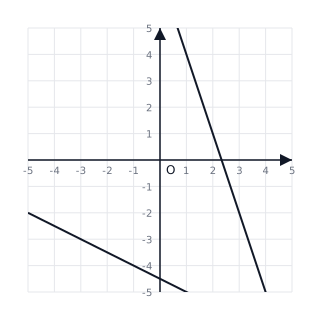
Find the acute angle between the lines 3x+yβˆ’7=03x + y - 7 = 0 and x+2y+9=0x + 2y + 9 = 0.

Graph of the two lines intersecting with an angle of 45 degrees.

Solution:

  1. Convert lines to slope-intercept form y=mx+cy = mx + c: Line 1: y=βˆ’3x+7β€…β€ŠβŸΉβ€…β€Šm1=βˆ’3y = -3x + 7 \implies m_1 = -3 Line 2: 2y=βˆ’xβˆ’9β€…β€ŠβŸΉβ€…β€Šy=βˆ’12xβˆ’92β€…β€ŠβŸΉβ€…β€Šm2=βˆ’122y = -x - 9 \implies y = -\frac{1}{2}x - \frac{9}{2} \implies m_2 = -\frac{1}{2}

  2. Use the angle formula: tan⁑θ=βˆ£βˆ’12βˆ’(βˆ’3)1+(βˆ’3)(βˆ’12)∣\tan \theta = \left| \frac{-\frac{1}{2} - (-3)}{1 + (-3)(-\frac{1}{2})} \right| tan⁑θ=βˆ£βˆ’12+31+32∣=∣5252∣=1\tan \theta = \left| \frac{-\frac{1}{2} + 3}{1 + \frac{3}{2}} \right| = \left| \frac{\frac{5}{2}}{\frac{5}{2}} \right| = 1

  3. Since tan⁑θ=1\tan \theta = 1, the acute angle ΞΈ=45∘\theta = 45^\circ (or Ο€4\frac{\pi}{4} radians).

Explanation:

Slopes are extracted from the general form Ax+By+C=0Ax+By+C=0 using m=βˆ’A/Bm = -A/B. The absolute value ensures the result is the acute angle.

Problem 4:

A line L1L_1 passes through (3,βˆ’2)(3, -2) and (βˆ’1,4)(-1, 4). Another line L2L_2 passes through (1,0)(1, 0) and is perpendicular to L1L_1. Find the equation of L2L_2 and the angle it makes with the x-axis.
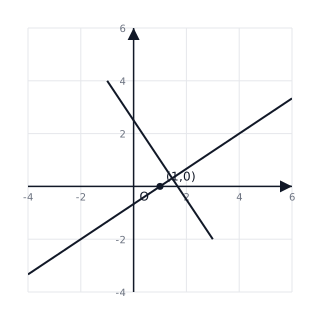
Two lines perpendicular to each other, with one passing through (1,0).

Solution:

  1. Find slope m1m_1 of L1L_1: m1=4βˆ’(βˆ’2)βˆ’1βˆ’3=6βˆ’4=βˆ’32m_1 = \frac{4 - (-2)}{-1 - 3} = \frac{6}{-4} = -\frac{3}{2}

  2. Since L2βŠ₯L1L_2 \perp L_1, m2=βˆ’1m1=23m_2 = -\frac{1}{m_1} = \frac{2}{3}

  3. Equation of L2L_2 using point (1,0)(1, 0): yβˆ’0=23(xβˆ’1)β€…β€ŠβŸΉβ€…β€Š2xβˆ’3yβˆ’2=0y - 0 = \frac{2}{3}(x - 1) \implies 2x - 3y - 2 = 0

  4. Angle with x-axis (inclination Ξ±\alpha): tan⁑α=m2=23β€…β€ŠβŸΉβ€…β€ŠΞ±=tanβ‘βˆ’1(23)\tan \alpha = m_2 = \frac{2}{3} \implies \alpha = \tan^{-1}(\frac{2}{3}).

Explanation:

The perpendicularity condition m1m2=βˆ’1m_1 m_2 = -1 is used to find the slope of the second line, which is then used in the point-slope form.