
Review the key concepts, formulae, and examples before starting your quiz.
🔑Concepts
Two lines are parallel if they have the same slope. In the general form, parallel lines are represented as and , where the coefficients of and are identical or proportional.
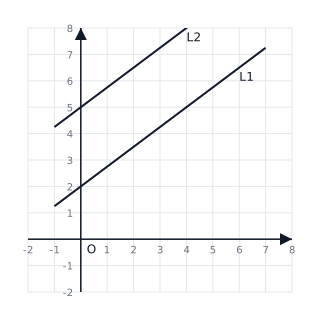
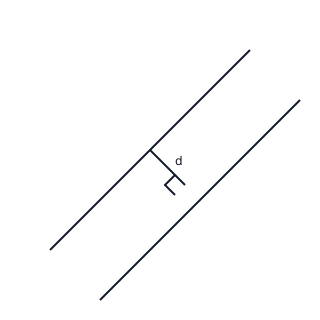
The distance between two parallel lines is the perpendicular distance from any point on one line to the other line. This distance is constant at all points along the lines.
If lines are given in slope-intercept form as and , the distance formula simplifies to .
When using the general form and , ensure the coefficients and are exactly the same in both equations before applying the formula .
📐Formulae
💡Examples
Problem 1:
Find the distance between the parallel lines and .
Solution:
Given lines are and . Comparing with and , we have: , , , and . Using the formula , we get: units.
Explanation:
Identify the common coefficients and and the constants and , then substitute them into the distance formula.
Problem 2:
Find the distance between the lines and .
Solution:
The first line is . The second line is . Dividing the second equation by to make coefficients of and same: . Now, , , , and . Using the formula: units.
Explanation:
Before using the formula, the coefficients of and must be identical. We divided the second equation by to match the first equation.
Problem 3:
Calculate the difference between the constant terms of the lines and using vertical subtraction for the numerator calculation.
Solution:
Here and . To find , we perform: . In vertical form for absolute values: Thus . The denominator is . The distance is units.
Explanation:
The distance is calculated by finding the absolute difference of the constants and dividing by the magnitude of the normal vector.
Problem 4:
Find the distance between the parallel lines and .
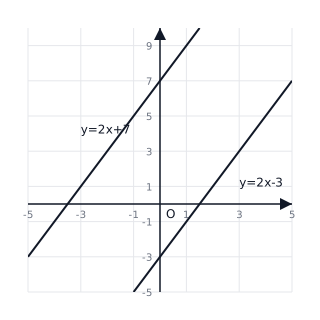
Solution:
- Identify the slope and intercepts : , , .
- Use the formula :
- Rationalize the denominator: units.
Explanation:
Since the lines are in form with the same slope , we directly subtract the y-intercepts and divide by the magnitude of the normal vector component.
Problem 5:
Find the distance between the lines and .
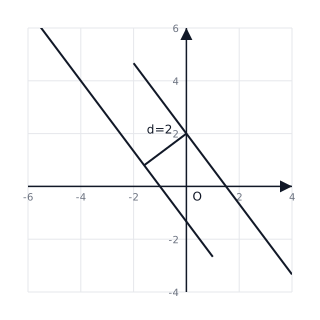
Solution:
- Normalize the first equation to match the coefficients of the second: Divide by 2:
- Now .
- Calculate the numerator : Absolute value is .
- Calculate the denominator : .
- Distance units.
Explanation:
To use the general distance formula, the coefficients of x and y must be identical in both equations. Dividing the first equation by 2 makes and for both.