
Review the key concepts, formulae, and examples before starting your quiz.
🔑Concepts
The normal form of a line is defined by two parameters: the length of the perpendicular (normal) from the origin to the line, denoted by , and the angle (omega) which this perpendicular makes with the positive direction of the -axis.
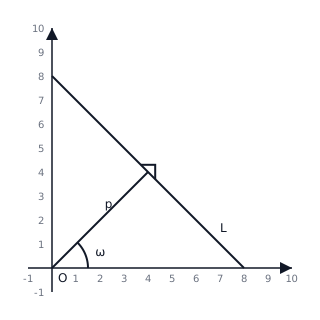
The length of the perpendicular is always non-negative (). If a general equation is reduced to normal form, the sign of the square root is chosen such that remains positive.
The angle is measured in the counter-clockwise direction from the positive -axis and lies in the interval . The position of the line in different quadrants depends on the signs of and .
To reduce to normal form, we rewrite it as . If is positive, we divide by . If is negative, we divide by to ensure the constant term on the right is positive.
📐Formulae
Standard Normal Form:
Normal length from origin:
Relationship for angle: and
Condition for :
Slope of the line in terms of :
💡Examples
Problem 1:
Find the equation of the line for which the length of the perpendicular from the origin is units and the angle which the perpendicular makes with the positive x-axis is .
Solution:
Step 1: Identify the given values. We have and . Step 2: Use the Normal Form equation . Step 3: Substitute the values: . Step 4: Evaluate trigonometric ratios: and . Step 5: Substitute these back into the equation: . Step 6: Simplify by multiplying the entire equation by : .
Explanation:
This is a direct application of the normal form. We simply plug the distance and the angle into the standard equation and simplify.
Problem 2:
Reduce the equation into normal form. Find the values of and .
Solution:
Step 1: Rewrite the equation as . Here, the constant term on the right is already positive (). Step 2: Calculate , where and . So, . Step 3: Divide the entire equation by : , which simplifies to . Step 4: Compare with . We find . Step 5: Determine from and . Both are positive, so is in the first quadrant. or .
Explanation:
To reduce a general equation to normal form, we divide by the magnitude of the coefficients' vector . This normalizes the coefficients so they represent the sine and cosine of the same angle.
Problem 3:
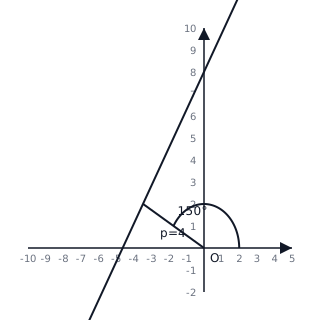
Find the equation of the line where the perpendicular distance from the origin is units and the angle which the normal makes with the positive -axis is .
Solution:
Given and . The normal form is . Substituting the values: Since and , Multiplying by : or .
Explanation:
We identify and from the question and substitute them into the standard normal form equation. Trigonometric values for are calculated using reference angles in the second quadrant.
Problem 4:
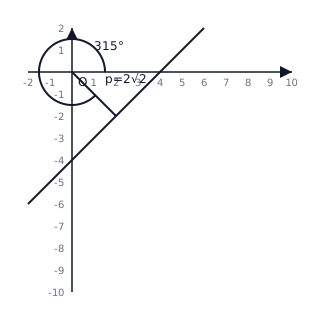
Reduce the equation into normal form and find the length of the perpendicular from the origin and the angle .
Solution:
The given equation is , which can be written as . Here . Divide both sides by . Comparing with : and Since is positive and is negative, lies in the 4th quadrant. (or radians).
Explanation:
To reduce to normal form, divide by . Ensure the constant is positive. Determine the quadrant of based on the signs of and .