krit.club logo

Straight Lines - Slope of a Line

Grade 11CBSE

Review the key concepts, formulae, and examples before starting your quiz.

🔑Concepts

•

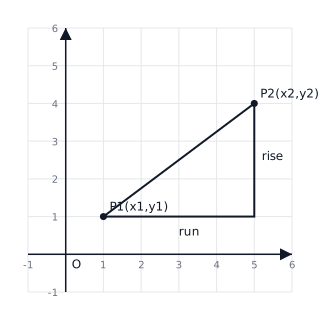
The slope (or gradient) mm of a non-vertical line passing through points (x1,y1)(x_1, y_1) and (x2,y2)(x_2, y_2) is defined as the ratio of the change in yy-coordinates to the change in xx-coordinates: m=y2−y1x2−x1m = \frac{y_2 - y_1}{x_2 - x_1}.

Coordinate plane showing a line passing through two points with rise and run indicated.
•

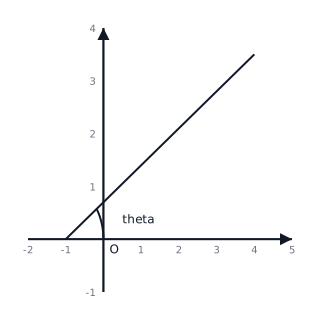
The inclination of a line is the angle θ\theta (0∘≤θ<180∘0^{\circ} \le \theta < 180^{\circ}) which the line makes with the positive direction of the x-axis, measured anti-clockwise. The slope is given by m=tan⁡θm = \tan \theta.

A line intersecting the x-axis at an angle theta.
•

Parallel lines have equal slopes (m1=m2m_1 = m_2), while the product of the slopes of two perpendicular lines is −1-1 (m1⋅m2=−1m_1 \cdot m_2 = -1).

•

Three points A,BA, B and CC are collinear if and only if the slope of ABAB is equal to the slope of BCBC.

📐Formulae

m=tan⁡θm = \tan \theta

m=y2−y1x2−x1,x1≠x2m = \frac{y_2 - y_1}{x_2 - x_1}, x_1 \neq x_2

m1=m2 (Condition for parallel lines)m_1 = m_2 \text{ (Condition for parallel lines)}

m1⋅m2=−1 (Condition for perpendicular lines)m_1 \cdot m_2 = -1 \text{ (Condition for perpendicular lines)}

tan⁡θ=∣m2−m11+m1m2∣ (Angle between two lines)\tan \theta = \left| \frac{m_2 - m_1}{1 + m_1 m_2} \right| \text{ (Angle between two lines)}

💡Examples

Problem 1:

Find the slope of a line passing through the points A(3,−2)A(3, -2) and B(−1,4)B(-1, 4).

Solution:

  1. Identify the coordinates: (x1,y1)=(3,−2)(x_1, y_1) = (3, -2) and (x2,y2)=(−1,4)(x_2, y_2) = (-1, 4).
  2. Use the slope formula: m=y2−y1x2−x1m = \frac{y_2 - y_1}{x_2 - x_1}.
  3. Substitute the values: m=4−(−2)−1−3m = \frac{4 - (-2)}{-1 - 3}.
  4. Simplify: m=4+2−4=6−4m = \frac{4 + 2}{-4} = \frac{6}{-4}.
  5. Final result: m=−32m = -\frac{3}{2}.

Explanation:

To find the slope between two points, we calculate the change in y-coordinates divided by the change in x-coordinates. A negative slope indicates the line falls from left to right.

Problem 2:

If the angle between two lines is π4\frac{\pi}{4} and the slope of one of the lines is 12\frac{1}{2}, find the slope of the other line.

Solution:

  1. Let m1=12m_1 = \frac{1}{2} and the unknown slope be m2m_2.
  2. The angle θ=π4\theta = \frac{\pi}{4}, so tan⁡θ=tan⁡(π4)=1\tan \theta = \tan(\frac{\pi}{4}) = 1.
  3. Use the formula: 1=∣m2−1/21+(1/2)m2∣1 = \left| \frac{m_2 - 1/2}{1 + (1/2)m_2} \right|.
  4. Remove the absolute value: m2−1/21+m2/2=1\frac{m_2 - 1/2}{1 + m_2/2} = 1 or m2−1/21+m2/2=−1\frac{m_2 - 1/2}{1 + m_2/2} = -1.
  5. Solve Case 1: m2−12=1+m22  ⟹  m22=32  ⟹  m2=3m_2 - \frac{1}{2} = 1 + \frac{m_2}{2} \implies \frac{m_2}{2} = \frac{3}{2} \implies m_2 = 3.
  6. Solve Case 2: m2−12=−1−m22  ⟹  3m22=−12  ⟹  m2=−13m_2 - \frac{1}{2} = -1 - \frac{m_2}{2} \implies \frac{3m_2}{2} = -\frac{1}{2} \implies m_2 = -\frac{1}{3}.
  7. The possible slopes are 33 or −13-\frac{1}{3}.

Explanation:

We use the tangent formula for the angle between two lines. Since the formula involve absolute values, there are typically two possible lines (slopes) that could form the given angle with the reference line.

Problem 3:

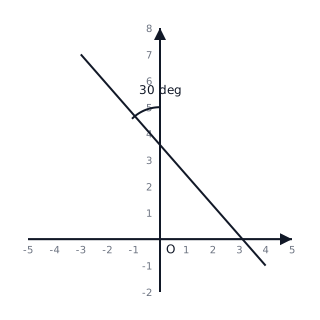
Find the slope of a line which makes an angle of 30∘30^{\circ} with the positive direction of the yy-axis measured anticlockwise.

A line passing through the second quadrant making a 30 degree angle with the y-axis.

Solution:

  1. The angle with the positive yy-axis is 30∘30^{\circ} anticlockwise.
  2. The angle with the positive xx-axis (inclination θ\theta) is 90∘+30∘=120∘90^{\circ} + 30^{\circ} = 120^{\circ}.
  3. Slope m=tan⁡120∘m = \tan 120^{\circ}.
  4. m=tan⁡(180∘−60∘)=−tan⁡60∘=−3m = \tan(180^{\circ} - 60^{\circ}) = -\tan 60^{\circ} = -\sqrt{3}.
  5. The slope of the line is −3-\sqrt{3}.

Explanation:

Since the inclination is measured from the positive xx-axis, we add the 90∘90^{\circ} angle between the xx and yy axes to the given 30∘30^{\circ} angle.

Problem 4:

Check if the points A(1,1)A(1, 1), B(2,3)B(2, 3), and C(3,5)C(3, 5) are collinear using the concept of slope.
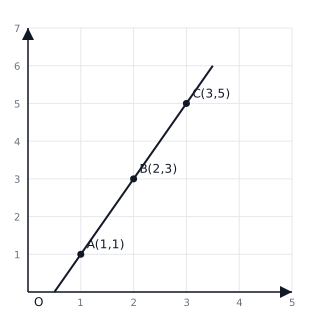
Graph showing points A, B, and C lying on the same straight line.

Solution:

  1. Calculate slope of ABAB: mAB=3−12−1=21=2m_{AB} = \frac{3 - 1}{2 - 1} = \frac{2}{1} = 2.
  2. Calculate slope of BCBC: mBC=5−33−2=21=2m_{BC} = \frac{5 - 3}{3 - 2} = \frac{2}{1} = 2.
  3. Since mAB=mBCm_{AB} = m_{BC} and BB is a common point, the points A,B,A, B, and CC are collinear.

Explanation:

Collinearity of three points can be established if the slope of the line segment joining the first two points is equal to the slope of the line segment joining the next two points.