
Review the key concepts, formulae, and examples before starting your quiz.
🔑Concepts
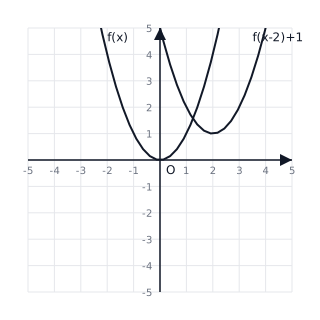
Vertical and Horizontal Translations: Adding a constant outside the function, , shifts the graph vertically by units. Subtracting a constant inside the function argument, , shifts the graph horizontally to the right by units.
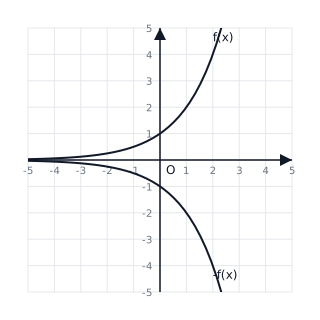
Reflections: Multiplying the entire function by , , reflects the graph across the -axis. Multiplying the input variable by , , reflects the graph across the -axis.
Vertical Stretches: Multiplying the function by a factor , , stretches the graph vertically away from the -axis if , or compresses it toward the axis if . Each -coordinate is multiplied by .
Horizontal Stretches: Multiplying the input by a factor , , results in a horizontal stretch by a factor of toward or away from the -axis.
📐Formulae
💡Examples
Problem 1:
Given the parent function , find the equation of the function that results from translating by units to the left and units up.
Solution:
Explanation:
To translate units to the left, we replace with , which is . To translate units up, we add to the entire function. Thus, .
Problem 2:
The point lies on the graph of . Determine the new coordinates of point on the graph of .
Solution:
Explanation:
The transformation shifts the graph unit to the right, so the -coordinate becomes . The transformation is a vertical stretch by a factor of , so the -coordinate becomes . The new coordinates are .
Problem 3:
Describe the transformations required to turn the graph of into .
Solution:
- Horizontal compression by a scale factor of from the -axis. 2. Reflection in the -axis.
Explanation:
The coefficient inside the square root () represents a horizontal stretch with scale factor , where , resulting in a compression. The negative sign outside the function () indicates a reflection across the -axis.
Problem 4:
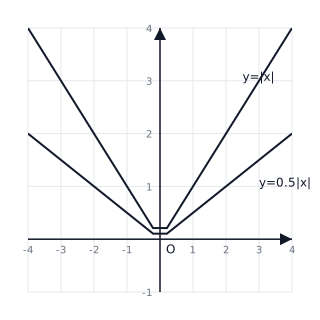
Given the function , describe and sketch the transformation .
Solution:
The transformation is a vertical stretch (or compression) by a scale factor of . For every point on , the new coordinates on will be . For example, becomes .
Explanation:
Since the multiplier is outside the absolute value sign and , the graph is compressed vertically toward the -axis.
Problem 5:
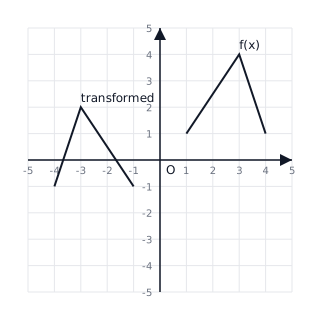
The graph of is shown in the plane. Sketch the graph of .
Solution:
- Reflect the graph of in the -axis to obtain .
- Translate the resulting graph downwards by units to obtain .
Explanation:
Replacing with performs a horizontal reflection. Subtracting from the result shifts every point down by units.