krit.club logo

Algebra - Exponential and logarithmic functions-extended

Grade 10IB

Review the key concepts, formulae, and examples before starting your quiz.

🔑Concepts

•

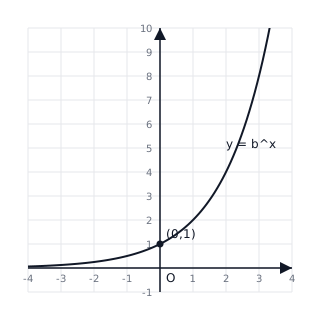
The exponential function f(x)=bxf(x) = b^x where b>1b > 1 represents exponential growth. The graph passes through the point (0,1)(0, 1) and has a horizontal asymptote at y=0y = 0. As xx increases, the value of yy increases rapidly.

Graph of an exponential growth function y = b^x showing the curve passing through (0,1).
•

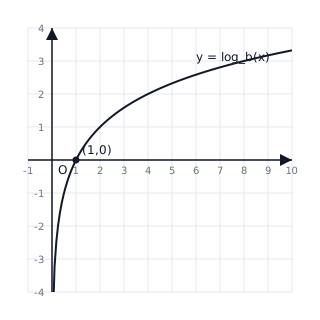
The logarithmic function f(x)=log⁡b(x)f(x) = \log_b(x) is the inverse of the exponential function bxb^x. Its graph is a reflection of y=bxy = b^x across the line y=xy = x. It has a vertical asymptote at x=0x = 0 and passes through (1,0)(1, 0).

Graph of a logarithmic function y = log_b(x) showing the curve passing through (1,0) and a vertical asymptote at the y-axis.
•

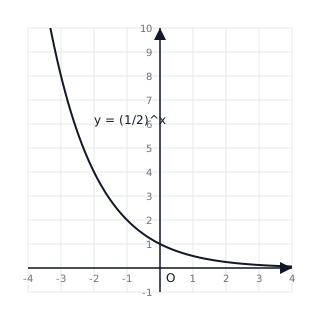
Exponential decay occurs when the base bb is between 00 and 11 (0<b<10 < b < 1). The graph of y=bxy = b^x still passes through (0,1)(0, 1), but as xx increases, yy approaches 00 from above.

Graph of an exponential decay function showing the curve decreasing as x increases.
•

Solving logarithmic equations often involves using the definition of a logarithm to convert the equation into exponential form: log⁡b(x)=y  ⟹  by=x\log_b(x) = y \implies b^y = x. Ensure that the argument of any logarithm is always positive.

📐Formulae

am×an=am+na^m \times a^n = a^{m+n}

aman=am−n\frac{a^m}{a^n} = a^{m-n}

(am)n=amn(a^m)^n = a^{mn}

amn=amna^{\frac{m}{n}} = \sqrt[n]{a^m}

log⁡b(x)=y  ⟺  by=x\log_b(x) = y \iff b^y = x

log⁡b(MN)=log⁡bM+log⁡bN\log_b(MN) = \log_b M + \log_b N

log⁡b(MN)=log⁡bM−log⁡bN\log_b\left(\frac{M}{N}\right) = \log_b M - \log_b N

log⁡b(Mk)=klog⁡bM\log_b(M^k) = k \log_b M

log⁡bb=1 and log⁡b1=0\log_b b = 1 \text{ and } \log_b 1 = 0

log⁡ba=log⁡calog⁡cb\log_b a = \frac{\log_c a}{\log_c b}

💡Examples

Problem 1:

Solve the exponential equation 3x+1=813^{x+1} = 81 for xx.

Solution:

Write both sides with the same base: 3x+1=343^{x+1} = 3^4 Equate the exponents: x+1=4x + 1 = 4 x=3x = 3

Explanation:

To solve an exponential equation where the bases can be made equal, rewrite the terms such that af(x)=ag(x)a^f(x) = a^g(x), then set f(x)=g(x)f(x) = g(x).

Problem 2:

Simplify the expression 2log⁡36−log⁡342\log_3 6 - \log_3 4.

Solution:

Apply the power rule: 2log⁡36=log⁡3(62)=log⁡3362\log_3 6 = \log_3 (6^2) = \log_3 36 Apply the quotient rule: log⁡336−log⁡34=log⁡3(364)\log_3 36 - \log_3 4 = \log_3 \left(\frac{36}{4}\right) log⁡39=log⁡3(32)\log_3 9 = \log_3 (3^2) =2log⁡33=2(1)=2= 2 \log_3 3 = 2(1) = 2

Explanation:

Used the power rule to move the coefficient into the exponent, then used the quotient rule to combine the logs, and finally simplified based on the definition of logarithms.

Problem 3:

Solve for xx: 5x=125^x = 12. Give your answer to 3 decimal places.

Solution:

Take the logarithm of both sides: log⁡(5x)=log⁡(12)\log(5^x) = \log(12) Apply the power rule: xlog⁡5=log⁡12x \log 5 = \log 12 Isolate xx: x=log⁡12log⁡5x = \frac{\log 12}{\log 5} x≈1.079180.69897≈1.544x \approx \frac{1.07918}{0.69897} \approx 1.544

Explanation:

When the bases cannot be easily equated, take the logarithm of both sides and use the power rule to bring the variable down from the exponent.

Problem 4:

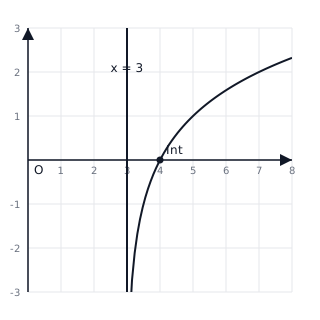
Given the function f(x)=log⁡2(x−3)f(x) = \log_2(x - 3), find the domain of the function and the coordinates of the point where the graph crosses the xx-axis.

Graph of y = log2(x-3) showing a vertical asymptote at x=3 and an x-intercept at (4,0).

Solution:

  1. For the domain, the argument of the logarithm must be positive: x−3>0x - 3 > 0 x>3x > 3 Domain: (3,∞)(3, \infty)
  2. To find the xx-intercept, set f(x)=0f(x) = 0: 0=log⁡2(x−3)0 = \log_2(x - 3) 20=x−32^0 = x - 3 1=x−31 = x - 3 x=4x = 4 The graph crosses the xx-axis at (4,0)(4, 0).

Explanation:

The domain is restricted because logarithms are only defined for positive values. The xx-intercept is found by converting the logarithmic equation to its equivalent exponential form.

Problem 5:

Solve for xx: 2x+2=5x2^{x+2} = 5^{x}. Give your answer to 2 decimal places.
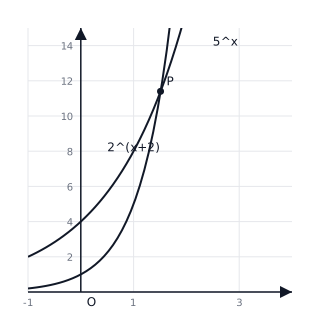
Graph showing the intersection of y = 2^(x+2) and y = 5^x at approximately x = 1.51.

Solution:

  1. Take the natural logarithm (ln⁡\ln) of both sides: ln⁡(2x+2)=ln⁡(5x)\ln(2^{x+2}) = \ln(5^x)
  2. Use the power rule log⁡(Mk)=klog⁡M\log(M^k) = k \log M: (x+2)ln⁡2=xln⁡5(x+2)\ln 2 = x \ln 5
  3. Expand and rearrange: xln⁡2+2ln⁡2=xln⁡5x \ln 2 + 2 \ln 2 = x \ln 5 2ln⁡2=xln⁡5−xln⁡22 \ln 2 = x \ln 5 - x \ln 2 2ln⁡2=x(ln⁡5−ln⁡2)2 \ln 2 = x(\ln 5 - \ln 2)
  4. Solve for xx: x=2ln⁡2ln⁡5−ln⁡2x = \frac{2 \ln 2}{\ln 5 - \ln 2} x≈1.38631.6094−0.6931x \approx \frac{1.3863}{1.6094 - 0.6931} x≈1.51x \approx 1.51

Explanation:

When the bases of an exponential equation cannot be made the same, we apply logarithms to both sides to bring the exponents down using the power property.