
Review the key concepts, formulae, and examples before starting your quiz.
🔑Concepts
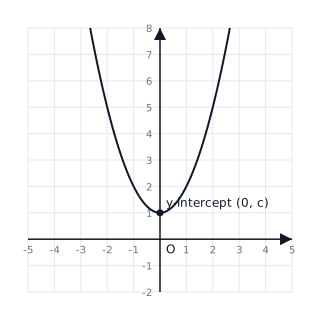
The standard form of a quadratic function is . The coefficient determines if the parabola opens upwards () or downwards (). The -intercept is always at .
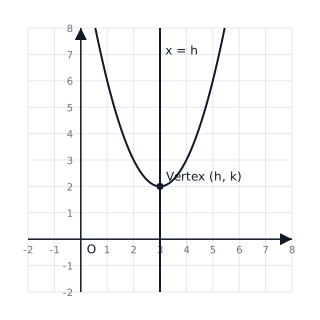
The vertex form directly identifies the vertex and the axis of symmetry . This form is obtained by completing the square from the standard form.
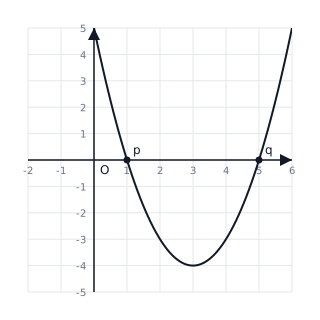
The intercept (factorized) form shows the -intercepts at and . The axis of symmetry is located exactly halfway between the intercepts at .
Transforming between forms involves algebraic manipulation. Expand vertex or intercept forms to reach standard form; use factoring to reach intercept form; use the vertex formula or completing the square to reach vertex form.
📐Formulae
, where and are roots.
(Axis of Symmetry)
(Discriminant to determine the number of -intercepts)
💡Examples
Problem 1:
Convert the quadratic function into vertex form.
Solution:
- Identify .
- Calculate : .
- Calculate : .
- Write in vertex form : .
Explanation:
To convert from standard to vertex form, we find the coordinates of the vertex using the formula and substituting that value back into the original function.
Problem 2:
Find the equation of a parabola in intercept form that has -intercepts at and and passes through the point .
Solution:
- Start with the intercept form: .
- Substitute the intercepts: .
- Use the point to find : .
- Solve for : .
- The final equation is .
Explanation:
By substituting the known roots into the intercept form, we create a template. We then use the provided coordinate to solve for the stretch factor .
Problem 3:
Identify the features of the function : Vertex, Axis of Symmetry, and direction of opening.
Solution:
- Compare to : here .
- Vertex: .
- Axis of Symmetry: .
- Direction: Since (which is ), the parabola opens downwards.
Explanation:
In vertex form, is the value subtracted from , so implies . The value of is added at the end. The sign of indicates whether the parabola is a 'U' shape or an 'n' shape.
Problem 4:
Determine the equation of the quadratic function shown in the graph, which has a vertex at and passes through the point . Express the answer in vertex form.
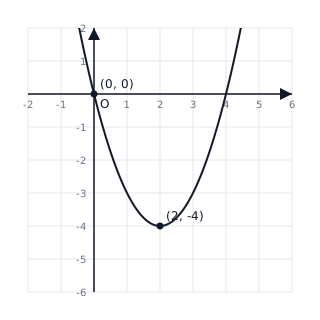
Solution:
- Start with the vertex form: .
- Substitute the vertex : .
- Use the point to solve for : .
- The equation is .
Explanation:
Vertex form is the most efficient choice when the turning point is known. Substituting another known point allows us to solve for the vertical stretch factor .
Problem 5:
A quadratic function is given by . Find its -intercepts by converting it to intercept form and sketch the graph.
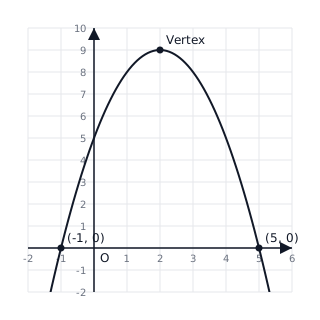
Solution:
- Factor out the negative sign: .
- Factor the quadratic expression: .
- Set to find intercepts: or .
- The -intercepts are and .
Explanation:
Factoring the standard form into intercept form reveals the roots of the function. Since , the parabola opens downwards.