
Review the key concepts, formulae, and examples before starting your quiz.
🔑Concepts
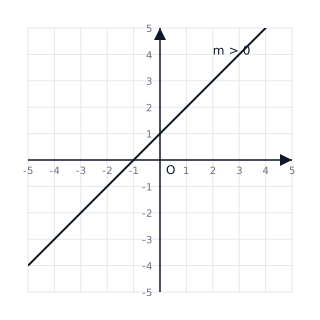
Linear functions follow the general form , where represents the gradient (slope) and represents the -intercept. The gradient determines the steepness and direction: a positive slopes upwards from left to right, while a negative slopes downwards.
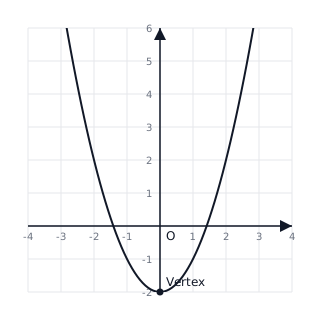
Quadratic functions are written in the form . The graph is a parabola. If , the parabola opens upwards (minimum point), and if , it opens downwards (maximum point).
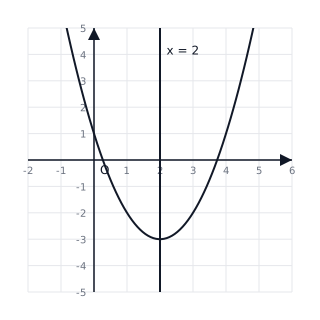
The Axis of Symmetry for a quadratic function is a vertical line passing through the vertex, given by the formula . This line divides the parabola into two congruent halves.
Intercepts: The -intercept is found by setting . The -intercepts (or roots) are found by setting . For quadratics, there can be zero, one, or two -intercepts depending on the discriminant .
📐Formulae
💡Examples
Problem 1:
Determine the gradient and y-intercept of the line , then find the x-intercept.
Solution:
- Rewrite in form: .
- Identify and : Gradient , y-intercept .
- Find x-intercept by setting : .
Explanation:
To analyze a linear graph, it is easiest to convert the equation to slope-intercept form. The x-intercept is found by solving for the point where the line crosses the horizontal axis ().
Problem 2:
For the quadratic function , find the coordinates of the vertex and the x-intercepts.
Solution:
- Find Axis of Symmetry ( coordinate of vertex): .
- Find coordinate of vertex: Substitute into the equation: . Vertex is .
- Find x-intercepts by factoring: . So, and .
Explanation:
The vertex is the turning point of the parabola. We use the formula for the axis of symmetry to find the x-value and substitute it back for the y-value. Factoring the quadratic allows us to see where the curve intersects the x-axis.
Problem 3:
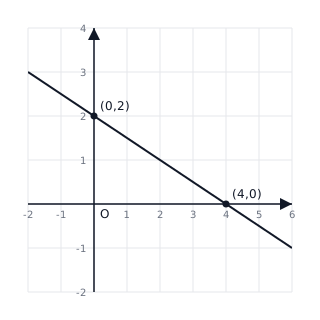
Sketch the graph of the linear function and identify its intercepts.
Solution:
- Find the -intercept by setting : . So, the point is .
- Find the -intercept by setting : . So, the point is .
- Plot and and draw a straight line through them.
Explanation:
The negative gradient indicates that for every 2 units moved to the right, the line moves 1 unit down.
Problem 4:
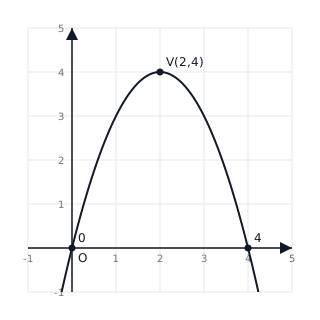
Identify the vertex and intercepts for the quadratic function .
Solution:
- For , and .
- -coordinate of vertex: .
- -coordinate of vertex: . Vertex is .
- -intercepts: set : or . Intercepts are and .
- Since , the parabola opens downwards.
Explanation:
The vertex is the maximum point of this downward-opening parabola.