
Review the key concepts, formulae, and examples before starting your quiz.
🔑Concepts
A function is a relation where each input from the domain corresponds to exactly one output in the range. In a mapping diagram, this means every element in the first set has exactly one arrow pointing away from it.
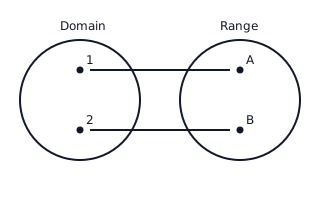
The Vertical Line Test is used to determine if a graph represents a function. If any vertical line intersects the graph at more than one point, the relation is not a function because one input would have multiple outputs.
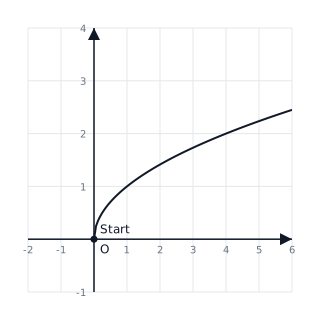
Domain refers to the set of all possible input values (-values). For a square root function , the domain is because we cannot take the square root of a negative number in real numbers.
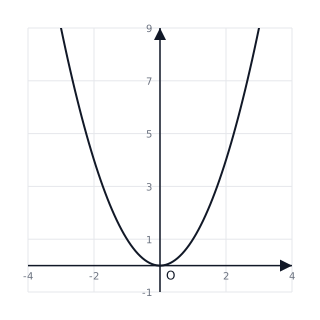
Range refers to the set of all possible output values (-values). For the function , the range is because squaring any real number results in a non-negative value.
📐Formulae
💡Examples
Problem 1:
Given the function , evaluate .
Solution:
- Substitute into the function:
- Calculate the square of :
- Perform the multiplications:
- Add the terms:
Explanation:
To evaluate a function for a specific value, replace the variable with the given number and follow the order of operations (BIDMAS/BODMAS).
Problem 2:
Determine the domain and range for the relation . Is this relation a function?
Solution:
- List the first elements for the Domain:
- List the unique second elements for the Range:
- Check for uniqueness: Each input () appears only once and is assigned to exactly one output.
Explanation:
The domain consists of all unique -coordinates, and the range consists of all unique -coordinates. Because no input value is repeated with a different output, the relation is a function.
Problem 3:
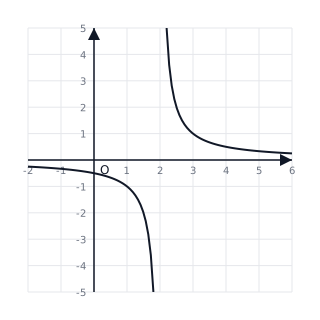
Identify the domain and range of the function and sketch its behavior near the vertical asymptote.
Solution:
The denominator cannot be zero, so , which means . Thus, Domain . Since the numerator is non-zero, can never be . Thus, Range .
Explanation:
The value causes division by zero, creating a vertical asymptote. As approaches from the right, goes to ; from the left, it goes to .
Problem 4:
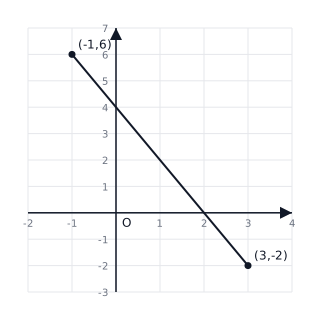
Determine the domain and range for the linear function on the restricted interval .
Solution:
- Domain is given as .
- Evaluate endpoints: and .
- Since it is a decreasing linear function, the range is .
Explanation:
For a linear function, the range over a closed interval is simply the interval between the -values of the endpoints.