
Review the key concepts, formulae, and examples before starting your quiz.
🔑Concepts
Lines are parallel if they have the same gradient. This means for two lines with equations and , they are parallel if . Parallel lines never intersect.
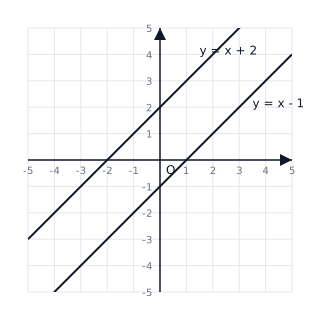
Lines are perpendicular if they meet at a right angle (). The product of their gradients is , expressed as . Alternatively, one gradient is the negative reciprocal of the other: .
The -intercept () does not affect whether lines are parallel or perpendicular; it only shifts the line vertically. Parallel lines must have different -intercepts to be distinct.
To find the equation of a new line, first determine its gradient based on the relationship (parallel or perpendicular) to a known line, then substitute a given point into the point-gradient formula .
📐Formulae
💡Examples
Problem 1:
Find the equation of the line that is parallel to and passes through the point .
Solution:
The given line has a gradient . Since the new line is parallel, its gradient is also . Using the point-gradient formula with :
Explanation:
Parallel lines share the same gradient. We identify the gradient from the reference equation and use the given point to solve for the new -intercept.
Problem 2:
Determine the equation of the line perpendicular to that passes through the point .
Solution:
The gradient of the given line is . The perpendicular gradient is the negative reciprocal: Now use the point in : The equation is .
Explanation:
To find a perpendicular gradient, flip the fraction and change the sign. Then, substitute the given coordinates to find the constant .
Problem 3:
Line passes through and . Line is defined by the equation . Determine if these lines are parallel, perpendicular, or neither.
Solution:
Find gradient of Line : Find gradient of Line by rearranging to : So, . Since , the lines are perpendicular.
Explanation:
By calculating the gradient of the first line and rearranging the second equation into form, we can compare their gradients. Their product is , confirming they are perpendicular.
Problem 4:
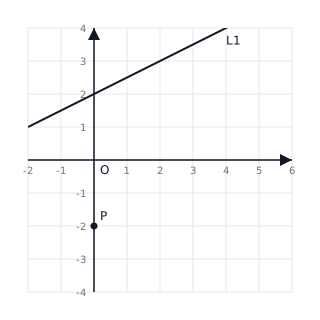
Find the equation of the line passing through point that is parallel to the line shown in the graph, which passes through and .
Solution:
- Find the gradient of :
- Since the new line is parallel, .
- Use the -intercept from point .
- The equation is .
Explanation:
Parallel lines share the same gradient. We calculate the gradient from the first line and apply it to the second line using the provided intercept.
Problem 5:
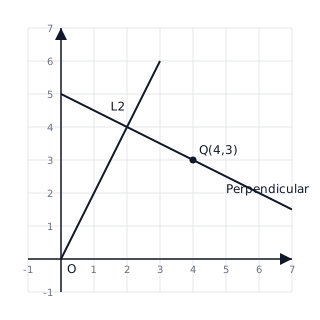
Find the equation of the line passing through the point that is perpendicular to the line , which passes through the points and . Show your answer in the form .
Solution:
-
Find the gradient () of line :
-
Determine the gradient () of the perpendicular line. Since the lines are perpendicular, :
-
Use the point-gradient form with point and :
Explanation:
To find a perpendicular line, we first identify the gradient of the reference line. The product of gradients for perpendicular lines is always . Once the new gradient is found, the specific equation is determined by substituting the coordinates of the given point into the linear equation.