
Review the key concepts, formulae, and examples before starting your quiz.
🔑Concepts
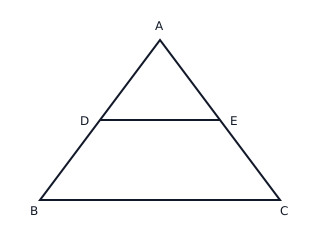
Basic Proportionality Theorem (Thales's Theorem): If a line is drawn parallel to one side of a triangle to intersect the other two sides in distinct points, then the other two sides are divided in the same ratio. In , if , then .
AA (Angle-Angle) Similarity Criterion: If two angles of one triangle are respectively equal to two angles of another triangle, then the two triangles are similar. If and , then .
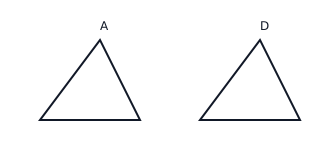
SAS (Side-Angle-Side) Similarity Criterion: If one angle of a triangle is equal to one angle of another triangle and the sides including these angles are proportional, then the triangles are similar. and .
SSS (Side-Side-Side) Similarity Criterion: If the corresponding sides of two triangles are proportional, then their corresponding angles are equal and the two triangles are similar.
📐Formulae
💡Examples
Problem 1:
In , . If , , and , find the value of .
Solution:
By Basic Proportionality Theorem (BPT), since , we have: Substituting the given values:
Explanation:
We apply Thales Theorem because the line is parallel to the base . The resulting linear equation is solved by cross-multiplication.
Problem 2:
A girl of height is walking away from the base of a lamp-post at a speed of . If the lamp is above the ground, find the length of her shadow after seconds.
Solution:
Let be the lamp-post and be the girl. Let be the shadow of length . Height of lamp-post . Height of girl . Distance walked in , . In and : (Common) Therefore, (AA similarity).
Explanation:
By using the AA similarity criterion between the large triangle formed by the lamp and the small triangle formed by the girl, we set up a proportion between heights and base lengths to find the shadow length.
Problem 3:
In the given figure, . Prove that . If , , and , find the length of .
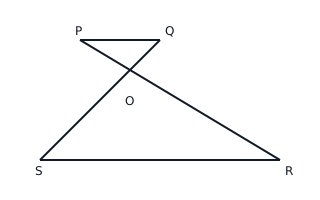
Solution:
- In and : (Alternate interior angles as ) (Alternate interior angles) (Vertically opposite angles)
- Therefore, by AA similarity criterion.
- Since triangles are similar, their sides are proportional:
Explanation:
We use the property that parallel lines intersected by transversals create equal alternate interior angles, establishing AA similarity. Corresponding sides of similar triangles are then set in a ratio to find the unknown length.
Problem 4:
A vertical pole of length casts a shadow long on the ground and at the same time a tower casts a shadow long. Find the height of the tower.
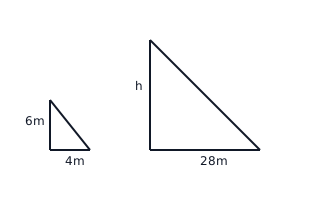
Solution:
- Let be the pole and be its shadow. Let be the tower and be its shadow.
- In and : (Vertical objects) (Angle of elevation of the sun is the same at the same time)
- By AA similarity, .
- Thus,
Explanation:
Since the sun's rays are parallel, the angles of elevation are equal, making the triangles formed by the objects and their shadows similar. We use the ratio of height to shadow length to find the tower's height.