
Review the key concepts, formulae, and examples before starting your quiz.
🔑Concepts
Two figures are said to be congruent if they have the same shape and the same size. Two figures having the same shape but not necessarily the same size are called similar figures. All circles, squares, and equilateral triangles are similar.
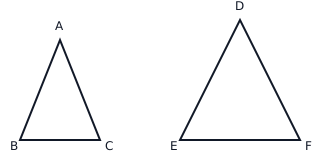
Two triangles are similar if their corresponding angles are equal and their corresponding sides are in the same ratio (proportional). Symbolically, .
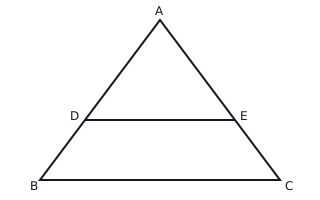
Basic Proportionality Theorem (Thales's Theorem): If a line is drawn parallel to one side of a triangle to intersect the other two sides in distinct points, the other two sides are divided in the same ratio. Conversely, if a line divides any two sides of a triangle in the same ratio, then the line is parallel to the third side.
Criteria for Similarity of Triangles include: AAA (Angle-Angle-Angle), AA (Angle-Angle), SSS (Side-Side-Side), and SAS (Side-Angle-Side). If any of these conditions are met, the triangles are similar.
📐Formulae
💡Examples
Problem 1:
In , and are points on sides and respectively such that . If , , and , find .
Solution:
By the Basic Proportionality Theorem (BPT), since , we have: Substituting the given values:
Explanation:
The BPT states that a line parallel to one side of a triangle divides the other two sides proportionally. We set up the ratio and solve for the unknown variable .
Problem 2:
In , and are points on and such that , , and . If , find the value of .
Solution:
Using BPT: Cross-multiplying gives:
Explanation:
We apply the proportionality property and use the algebraic identity to simplify the equation.
Problem 3:
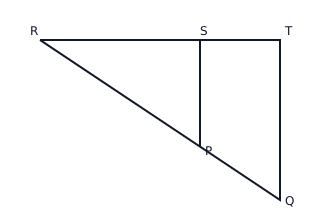
In the given figure, . If cm, cm and cm, find the length of .
Solution:
In , . By Basic Proportionality Theorem: Substitute the given values: The length of is .
Explanation:
Since a line segment is parallel to side of , the segments on the other two sides are proportional according to the Thales's Theorem.
Problem 4:
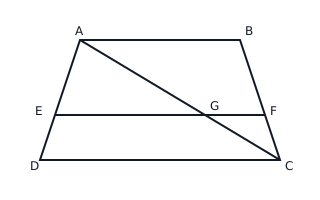
In the figure, is a trapezium with . If points and lie on and respectively such that , prove that .
Solution:
Join to intersect at point . In , (since and ). By BPT: ... (1) In , . By BPT: , which is ... (2) From (1) and (2): Hence proved.
Explanation:
By drawing a diagonal, we create two triangles. Applying the Basic Proportionality Theorem to both triangles allows us to link the ratios of the non-parallel sides through a common ratio on the diagonal.