
Review the key concepts, formulae, and examples before starting your quiz.
🔑Concepts
Similar figures have the same shape but not necessarily the same size. For polygons, they are similar if: (i) all corresponding angles are equal and (ii) all corresponding sides are in the same ratio (proportionality).
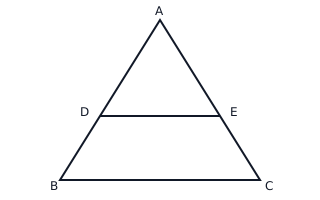
Basic Proportionality Theorem (Thales's Theorem): If a line is drawn parallel to one side of a triangle to intersect the other two sides in distinct points, the other two sides are divided in the same ratio.
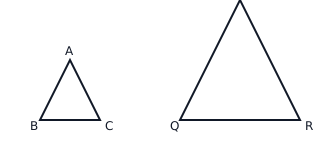
AAA (Angle-Angle-Angle) Similarity Criterion: If in two triangles, corresponding angles are equal, then their corresponding sides are in the same ratio and hence the two triangles are similar.
SSS (Side-Side-Side) Similarity Criterion: If in two triangles, sides of one triangle are proportional to the sides of the other triangle, then their corresponding angles are equal and the triangles are similar.
SAS (Side-Angle-Side) Similarity Criterion: If one angle of a triangle is equal to one angle of the other triangle and the sides including these angles are proportional, then the two triangles are similar.
📐Formulae
💡Examples
Problem 1:
In , . If , , and , find the value of .
Solution:
By Basic Proportionality Theorem, since : Substituting the given values:
Explanation:
We applied the Thales Theorem (BPT) which states that a line parallel to one side of a triangle divides the other two sides proportionally. Cross-multiplying the ratios leads to a quadratic equation where the terms cancel out, leaving a simple linear equation for .
Problem 2:
A vertical pole of length casts a shadow long on the ground and at the same time a tower casts a shadow long. Find the height of the tower.
Solution:
Let the height of the tower be . The triangles formed by the pole and its shadow, and the tower and its shadow, are similar because the angle of elevation of the sun is the same for both.
Explanation:
This uses the AA similarity criterion. Both the pole and the tower are vertical (90 degrees to the ground) and the sun's rays hit them at the same angle at the same time, making the triangles similar. Thus, the ratio of their heights is equal to the ratio of their shadows.
Problem 3:
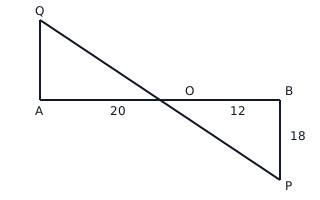
In the given figure, and . If , and , find the length of .
Solution:
In and :
- (Given)
- (Vertically opposite angles) By AA similarity criterion, . Therefore, the corresponding sides are proportional:
Explanation:
We first prove the two triangles are similar using the AA criterion by identifying equal right angles and vertically opposite angles. Then, we set up a proportion using the corresponding sides to solve for the unknown length.
Problem 4:
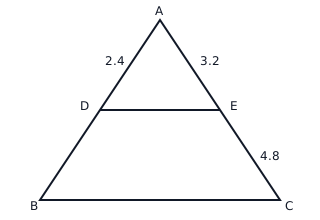
In , and are points on sides and such that . If , and , find .
Solution:
According to the Basic Proportionality Theorem (BPT), since : Now, :
Explanation:
Applying the BPT allowed us to find the segment DB. Adding the given segment AD and the calculated segment DB gives the total length of side AB.