
Triangles - Differentiate similar and congruent triangles using definitions and counterexamples
Review the key concepts, formulae, and examples before starting your quiz.
🔑Concepts
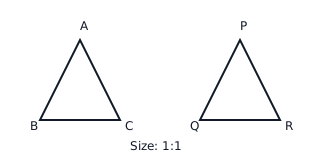
Congruent Triangles are 'identical' in both shape and size. Two triangles are congruent if their corresponding sides are equal and their corresponding angles are equal. Symbol: .
Similar Triangles have the same shape but not necessarily the same size. Two triangles are similar if their corresponding angles are equal and their corresponding sides are in the same ratio (proportional). Symbol: .
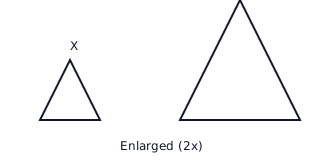
Key Differentiator: All congruent triangles are similar (ratio ), but not all similar triangles are congruent. Similarity is a scaling transformation, while congruence is a rigid transformation.

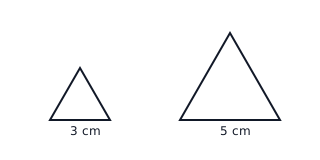
Counterexample for Congruence: Two equilateral triangles with sides and respectively have equal angles ( each), making them similar, but they are NOT congruent because their side lengths differ.
📐Formulae
If , then , , and .
Side Ratio:
Basic Proportionality Theorem: In , if , then .
Corollary of BPT: and .
Area Ratio (for reference): (Note: Often used in advanced similarity problems).
💡Examples
Problem 1:
In , . If , , , and , find the value of .
Solution:
- By Basic Proportionality Theorem (BPT), since , we have:
- Substitute the given values:
- Cross-multiply:
- Simplify:
- Subtract from both sides:
- Therefore, .
Explanation:
We apply the Thales Theorem which states that a line parallel to the base of a triangle divides the other two sides proportionally. We then solve the resulting algebraic equation for .
Problem 2:
A vertical pole of length casts a shadow long on the ground and at the same time a tower casts a shadow long. Find the height of the tower.
Solution:
- Let be the pole and be its shadow. Let be the tower and be its shadow.
- In and , (Vertical structures).
- (Angle of elevation of the sun is the same for both at the same time).
- Therefore, by AA similarity criterion.
- Thus,
- .
Explanation:
This problem uses the AA similarity criterion. Since the sun's rays hit the earth at the same angle for both objects, the triangles formed by the objects and their shadows are similar, allowing us to use side proportions.
Problem 3:
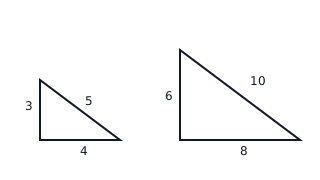
Check if with sides and with sides are similar or congruent.
Solution:
Since all corresponding sides are in the same ratio , the triangles are similar by SSS similarity criterion. However, since the sides are not equal (), they are not congruent.
Explanation:
Triangles are similar because their sides are proportional. They are not congruent because their sizes are different.
Problem 4:
In , . If , , and , find the length of . Is ?
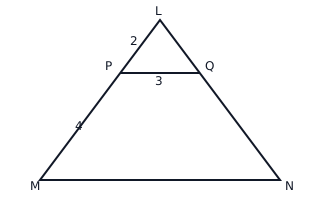
Solution:
In and :
- (Common)
- (Corresponding angles as ) Therefore, (AA Similarity). By property of similarity:
Explanation:
Parallel lines create corresponding angles, leading to similar triangles where side ratios are equal.