
Review the key concepts, formulae, and examples before starting your quiz.
🔑Concepts
The Converse of the Basic Proportionality Theorem (Thales' Theorem) states that if a line divides any two sides of a triangle in the same ratio, then the line must be parallel to the third side.
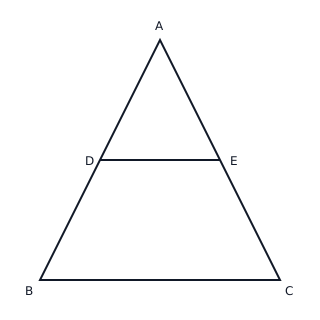
Mathematically, for a triangle , if a line intersects at and at such that , then .
The converse also holds true for the 'whole side' ratios. If , it implies that the segments are proportional and the lines are parallel.
To prove parallelism, calculate the numerical value of the ratio on the left side and the right side independently. If the simplified fractions are equal, parallelism is established.
📐Formulae
💡Examples
Problem 1:
In , and are points on the sides and respectively. If , , , and , determine whether .
Solution:
To check if , we must calculate the ratios of the segments on both sides:
-
Calculate the ratio on side : Dividing both by :
-
Calculate the ratio on side : Dividing both by :
Since , by the Converse of Basic Proportionality Theorem, .
Explanation:
We compare the ratio of the parts created by the line on side and side . Because both ratios simplify to the same value ( or ), the line divides the sides proportionally, satisfying the condition for parallelism.
Problem 2:
In , and are points on and respectively such that , , , and . Show that .
Solution:
We are given the total lengths of the sides and the lengths of the upper segments. We can use the alternative form of the Converse of BPT ratio:
-
Ratio on side :
-
Ratio on side :
Since , the segments are divided in the same ratio. Therefore, by the Converse of Basic Proportionality Theorem, .
Explanation:
The Converse of BPT can be applied using the ratio of the small segment to the whole side length. If is consistent for both sides, the line joining the points is parallel to the base.
Problem 3:
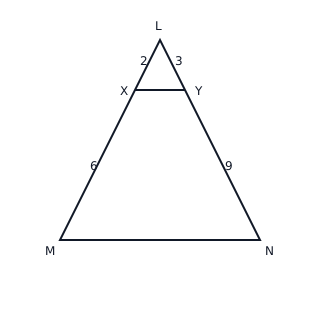
In , points and lie on and respectively. If , , , and , prove that .
Solution:
Given: , ,
Step 1: Calculate the ratio on side :
Step 2: Calculate the ratio on side :
Step 3: Compare ratios: Since , by the Converse of Basic Proportionality Theorem, .
Explanation:
By checking the ratios of the segments created by the line on the two sides of the triangle, we find they are identical (). This satisfies the condition for the converse of BPT.
Problem 4:
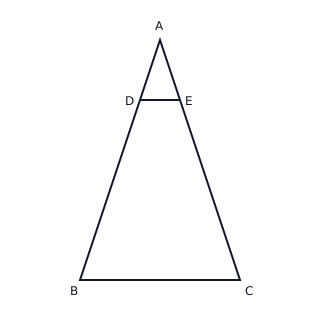
In , is a point on and is a point on . If , , , and , is ?
Solution:
Given: , ,
Step 1: Calculate the ratio :
Step 2: Calculate the ratio :
Step 3: Conclusion: Since , the line divides the sides and in the same ratio. Therefore, by the Converse of Basic Proportionality Theorem.
Explanation:
Even when full side lengths are given, the ratio of the small part to the whole side must be equal for both sides to prove parallelism.