
Review the key concepts, formulae, and examples before starting your quiz.
🔑Concepts
The AA (Angle-Angle) Similarity Criterion states that if two angles of one triangle are equal to two angles of another triangle, then the triangles are similar. This implies the third angles must also be equal due to the angle sum property.
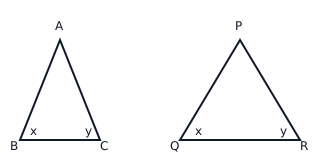
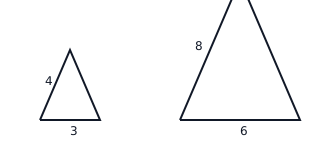
The SSS (Side-Side-Side) Similarity Criterion states that if the corresponding sides of two triangles are in the same ratio (proportional), then their corresponding angles are equal and the triangles are similar.
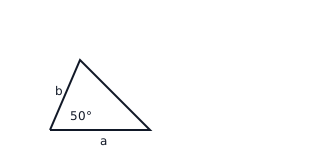
The SAS (Side-Angle-Side) Similarity Criterion states that if one angle of a triangle is equal to one angle of another triangle and the sides including these angles are proportional, then the triangles are similar.
Property of Similarity: If , then the ratio of any two corresponding sides is equal to the ratio of their corresponding altitudes, medians, or perimeters.
📐Formulae
If , then
Proportionality Ratio:
Basic Proportionality Theorem: If , then
Corollary of BPT:
Ratio of Perimeters:
💡Examples
Problem 1:
In , and are points on sides and respectively such that . If , , , and , find the value of .
Solution:
- By the Basic Proportionality Theorem, since , we have:
- Substitute the given values:
- Cross-multiply to solve for :
- Simplify the equation:
Thus, the value of is .
Explanation:
This problem applies the Basic Proportionality Theorem (BPT). When a line is parallel to one side of a triangle, it divides the other two sides proportionally. We set up a ratio, cross-multiplied, and solved the resulting quadratic-style equation which simplified to a linear one.
Problem 2:
A vertical pole of length casts a shadow long on the ground and at the same time a tower casts a shadow long. Find the height of the tower.
Solution:
- Let be the pole and be its shadow. Let be the tower and be its shadow.
- At the same time, the angle of elevation of the sun is the same for both. Therefore, .
- Also, both the pole and the tower are vertical, so .
- By AA similarity criterion, .
- Therefore, the ratios of corresponding sides are equal:
- Substitute the known values ():
\ - Solve for :
Explanation:
This is a real-world application of AA Similarity. Since the sun's rays hit the earth at the same angle for both objects at the same time, the triangles formed by the objects and their shadows are similar. This allows us to use side proportions to find the unknown height.
Problem 3:
In the given figure, and . Show that .
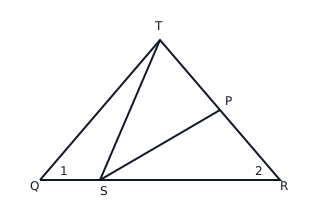
Solution:
- In , given . Thus, (sides opposite to equal angles are equal).
- We are given the ratio: .
- Substituting into the ratio, we get: .
- In and :
- (from step 3)
- (Common angle)
- Therefore, by SAS similarity criterion, .
Explanation:
This problem uses the property of isosceles triangles to substitute one side in a given ratio, fulfilling the SAS criteria requirements.
Problem 4:
and are points on sides and of such that . Show that .
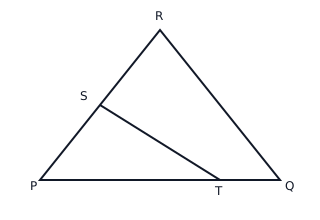
Solution:
- Consider and .
- (Given).
- (Common angle).
- Since two angles of are equal to two angles of , by the AA similarity criterion, .
Explanation:
The AA criterion is the most direct way to prove similarity when two angles (one given and one common) are identified.